
Each story — the ones we tell ourselves that make up our reality and the ones that creatives make for the books, shows, and films we ingest — is a matter of perspective and, frequently, the audience is rarely asked to consider the one on the outskirts of the central plotline. This is especially true in time loop stories like Groundhog Day (1993), Looper (2012), and Palm Springs (2020) as the people caught in the loops provide the perspective of someone caught in a temporal event they can’t explain but must address in order to break free. Having its North American premiere during Fantasia International Film Festival 2025 is Rewrite (リライト), the latest project from director Daigo Matsui (Just Remembering), an adaptation of the 2012 Haruka Hôjô novel by Beyond the Infinite Two Minutes/River writer Makoto Ueda, which takes the perspective we’re used to and flips it upside down. What starts as a stereotypical time loop sci-fi fantasy rom-com turns into an introspective exploration of love and meaning that’s unafraid to touch on the darker aspects that exist on the periphery of time loop stories.

L-R: Elaiza Ikeda as Miyuki Ishida and Kei Adachi as Yasuhiko Sonoda in REWRITE. Photo courtesy of Fantasia International Film Festival.
It was a summer day like any other for Miyuki Ishida (Elaiza Ikeda) and her class when transfer student Yasuhiko Sonoda (Kei Adachi) arrived. But all of that changed when a chance encounter revealed to her the truth of Yasuhiko — he’s from the year 2311 and is visiting the past thanks to a story he found in a bookstore. The pair become inseparable until the day that he needs to leave and return home, tasking Miyuki with a special request before he goes. Ten years later, with the task nearly finished, Miyuki comes upon some unexpected resistance, leading her to reexamine those 20 days of summer fun and youthful romance which will change her future once more.
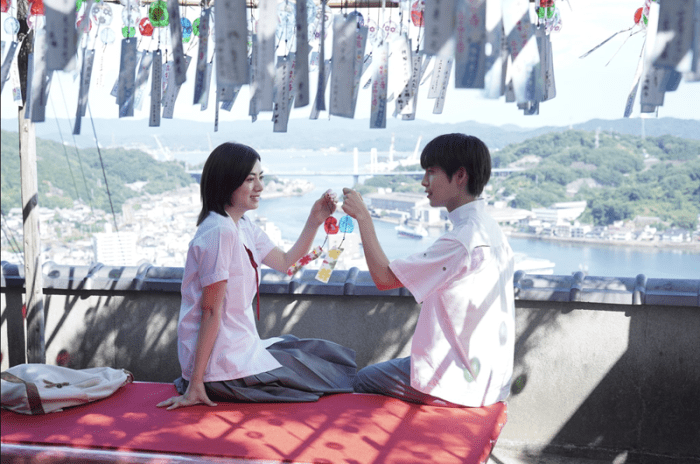
L-R: Elaiza Ikeda as Miyuki Ishida and Kei Adachi as Yasuhiko Sonoda in REWRITE. Photo courtesy of Fantasia International Film Festival.
Time loop stories are by no means an American creation and, if you’re an anime fan, you may notice a bit of similarity between what transpires in Rewrite as another tale, The Girl Who Leapt Through Time (2006) from Mamoru Hosoda (Summer Wars; Wolf Children) or perhaps The Girl Who Leapt Through Time (1997) from Haruki Kadokawa (Rex: A Dinosaur’s Story), or even The Little Girl Who Conquered Time (1983) from Nobuhiko Obayashi (House; His Motorbike, Her Island). It certainly appears as though Hôjô drew some inspiration as Yasuhiko is traveling through time; the concept of time loops, paradoxes, and destiny are explored by all the characters involved; and, perhaps in a tip of the hat to Conquered specifically, it involves the use of lavender. This is worth mentioning to point out one interpretation of the title itself as a statement on these other stories — this is a rewrite, meaning that the bones may be similar, potentially even the same, but the execution is of a different making, a unique perspective, thereby making something new. While a position could be made that a rewrite is little more than adaptation itself, in this case, it’s borrowing foundational elements to take the story we know and reshape it. Smartly, Rewrite takes its time setting up the premise so that the emotional stakes are ripe before the turn comes, kicking off what the internal struggle is and establishing how expectations and perspective are always specific to the protagonist of the story, but that doesn’t mean there’s not another view to consider. This is integral to feeling the full force of what Matsui seeks to accomplish, but, be forewarned, it means using a lot of book-based tropes to get there. So if you’re not a fan of extensive exposition narration and heavily dramatized young love, brace yourself, because the first act may feel a tad rough, intentionally or otherwise.
We need this perspective, however, Miyuki’s specifically, in order to get the appropriate setup and investment. What helps set the film apart from other young adult rom-com dramas is that Miyuki starts off on her mission in order to help the person she loved for 20 intense days, but ends up growing as a result of the mission and builds a life for herself between a job and husband. The story isn’t specifically about the two being reunited, rather, it’s about them being able to spend that time together in the first place. Without her completing the request, his reason for coming to 2011 doesn’t happen and none of this occurs; she’s motivated by ensuring that her present and past are protected. What Matsui and Ueda then do with this is take the audience for a ride in which everything we think we know is rolled over and examined as Miyuki runs into obstacle after obstacle, even things she believes are meant to be. If what’s set in stone doesn’t happen based on expectation, is, then, anything else rock solid? This questioning, this uncertainty, further helps separate Rewrite from other time loop stories because the focus isn’t as much on escaping the time loop via internal growth, but on the individuals around the trapped individual and how their choices create the ripple necessary for the loop to begin. Pushing things even further, and this is where things get dark, is the identification of unintended consequences.

Kei Adachi as Yasuhiko Sonoda in REWRITE. Photo courtesy of Fantasia International Film Festival.
Too few time loop stories explore the ramifications of or the impact on those around the looped individual. We typically only see things from the POV of the looper, therefore, incidents, accidents, and allegations are rarely, if ever, explored, given that support characters are more often treated as props for the looper to engage with in their bid to get back to normalcy. In Rewrite, by shifting away from Yasuhiko, Matsui and Ueda create an opportunity to investigate the ramifications that occur based on the looper’s choices. In one instance, this means someone who lost all sense of their reason in light of the truth they learned, causing them to lash out on society at large. For another, a deliberate choice away from their passion toward a career far less successful. For another and another and another, the script explores the ways in which Yasuhiko, who only wanted to come to 2011 because of how beautiful it sounded, created a dramatic change in everyone he touched, regardless of whether he used his lavender-scented memory-eraser on individuals or not. Groundhog Day toys with this a little bit, whereas Palm Springs makes the narcissistic tendencies of its male lead a critical point of the narrative. In this way, Rewrite inspires audiences to consider that maybe the way we treat people, regardless of their situation, matters for the way it impacts them in the long run versus today. Put another way, the actions of the past and present are written, but, the future, that’s an opportunity to rewrite everything for a better tomorrow.

L-R: Elaiza Ikeda as Miyuki Ishida and Kei Adachi as Yasuhiko Sonoda in REWRITE. Photo courtesy of Fantasia International Film Festival.
With this in mind, Rewrite manages to stick its landing. What starts as a young adult coming-of-age rom-com with all the tropes one can imagine, something more adult and ensemble-focused evolves which asks the audience, on multiple occasions, to question the journey they’re on. A certain amount of re-evaluation of one’s youth is important as blind faith, no matter how seemingly innocently it may all begin, can place people into situations they never should have been in in the first place. Considering that Ueda is responsible for two of the most tightly-written time loop stories in recent memory, make sure to pay attention because not everything gets explained (what does get extra explanation bums me out for not trusting the audience to work it out themselves), so what may seem like a plot hole may not be. There’s such focus to detail, some of which creates an oxymoronic joyful anguish, that a rewatch of Rewrite is almost a necessity.
Screening during Fantasia International Film Festival 2025.
For more information, head to the official Fantasia International Film Festival Rewrite webpage.
Final Score: 4 out of 5.


Share this:

Categories: In Theaters, Reviews
Leave a Reply