
When it comes to cheating and cheaters, there’s often more than one side to the story. Someone wasn’t getting what they needed from one partner, so they sought it elsewhere. This, of course, doesn’t make the act of cheating correct or proper, especially when one could just end the relationship first (awkward an unraveling as that might be), but the collateral damage is certainly far less in that case than in pretending something is working when it’s not. Or, you could just kill them. The latter takes center stage in the satirical dramedy Ten Women in Black (黒い十人の女) written by Natto Wada (The Burmese Harp) and directed by Kon Ichikawa (The Burmese Harp) as nine mistresses and a wife decide to end their collective suffering by murdering the philandering man who’s brought them together. Originally released in 1961 and restored in 2025 by Kadokawa Pictures, the film is now offered in a 4K HD restoration for home viewing by Radiance Films and it’s accompanied by one new featurette, an archival documentary, theatrical trailers, and a brand-new essay.
TV producer Matsuyoshi Kaze (Eiji Funakoshi) is exhausted. He’s constantly working late and getting up early due to the pressures of constantly producing hit programming. He’s also managed to rack up nine different mistresses who work in some capacity with his studio, earning himself a reputation around the lot and rumblings of impropriety. The mistresses, of course, are aware of each other and his wife, Futzba Kaze (Fujiko Yamamoto), is aware of all of them. In each case, they know that Matsuyoshi is bad for them, but they can’t seem to break free — until, that is, they hatch a plot to get rid of him for good. It’s a choice that brings with it only the kind of perspective that comes having gone past the point of no return.
The following home release review is based on a Blu-ray retail copy provided by Radiance Films via MVD Entertainment Group.
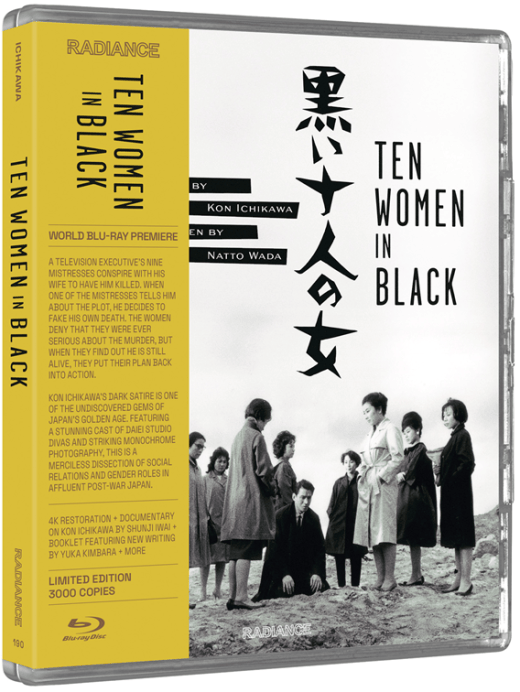
As with most Radiance Films titles, the film is packaged within its standard clear plastic disc case with reversible liner and removeable OBI strip with release information. The OBI strip is gold with black text stating the title, film information, and release information. The front of the liner depicts the dream sequence in the film in which the 10 women surround Matsuyoshi on a beach and force him to swallow several pills, while the back depicts a moment later in the scene with Matsuyoshi, Futzba, and Miwako (Mariko Miyagi). Perhaps it’s because there’s mostly white in the monochromatic image, but there’s a lightness to the scene that helps convey the silliness within the film that lightens the very real drama. The reverse of the liner, however, flips the color with the bulk being black and the text in white, infusing the film with a greater sense of desperation and depravity (which misrepresents the film quite a bit). As is typically the case, the reverse is likely based on an original theatrical poster or the artwork of a prior home release edition. The included disc is the same gold as the OBI strip with all the text in black. It’s a simple design that matches the visual flair of past Radiance titles.
As always, the goodies begin with the included booklet that accompanies the limited edition versions of Radiance titles. This time, that means the usual cast and crew information, various stills from the film, restoration information, and an essay from film critic Yuka Kimbara. Their essay, “A Merciless Slap,” offers context on the working relationship between director Ichikawa and writer Wada, their former use of Wada as a shared pseudonym, the film as a reaction to their past work, and the curiosity that drives the narrative. Kimbara utilizes quotes from Wada and Ichikawa to directly bring the creatives’ own thoughts forward, enabling Kimbara to bring to light questions we may possess. Certainly, the one most frustratingly not answered is why Kaze is desirable to these women at all. Or, if like Kimbara points out, Kaza is Japanese for “wind,” so maybe it’s not important to have all the answers about the mysterious figure and remove him entirely, reframing the attention on the women and the choices they make as a result of feeling some strange pull and compulsion through their connection to him.
Moving to the disc itself, the bonus features for Ten Women are minimal here with the star of the show being (1) access to the film itself in its first-time-on-Blu-ray form and (2) the 4K HD restoration. To that end, the film includes the original uncompressed mono audio soundtrack, brand-new English subtitle translations, two theatrical trailers, the aforementioned archival documentary (the feature-length The Kon Ichikawa Story), and a brand-new interview. The archival documentary The Kon Ichikawa Story from 2006 is directed by Shunji Iwai (All About Lily Chou-Chou) and focuses on the life and career of Ichikawa and Wada, his wife and frequent collaborator. The documentary description on the disc points out that due to copyright reasons, the documentary has received additional edits to remove about three minutes of footage, resulting in a 79-minute feature instead of the previously screened 82. The new featurette is an interview with Yasuharu Konishi, a musician, composer, and DJ (as well as a member of Pizzicato Five), who stumbled upon Ten Woman in Black during a retrospective event honoring several creatives (specifically Wada) and how he was taken with the film. He also shares his own specific experience of meeting and collaborating with Ichikawa across as 21-minute interview. This is a very personal conversation that delves primarily into Konishi’s experience, so for more historical and/or contextual information, refer to either the documentary or essay.
According to the booklet, the film was digitally restored by Kadokawa and given to Radiance as a high-definition digital master, which was then used to create this on-disc presentation in the original aspect ratio with the original audio track. Regardless of whether you get this limited-edition version or wait for a standard edition, this information should be somewhat available as the film both begins and ends with a note about the restoration. Specifically, the start of the film includes the year of the restoration (2025), that it’s a digital restoration, which company undertook it, and who personally oversaw different aspects. This information is rarely provided at the start of restorations unless the project began separately from the home release and, frankly, I wish it were included more often. While it’s not the sort of information the average person would want to have readily available, it is something that someone who decides to pick up a title from a boutique like Radiance would want to have regardless of limited or standard edition. As expected from past restoration offerings, Ten Women in Black looks and sounds fantastic. As a dark comedy, the monochrome cinematography perfectly encapsulates and conveys the tone of the film, which would be otherwise somewhat romantic if not for the deception, abdication of personal responsibility by many of the men depicted in the film, and, of course, attempted murder. Though it’s an HD restoration (not UHD), there’s still lovely detail in each frame which helps to delineate objects and people in night sequences (such as the opening that introduces eight of the mistresses) and ensures we can understand as much within the frame as possible during the daytime sequences. The audio and video both contain no sense of grime or wear in the presentation, allowing the audience to just experience the film as the filmmakers’ intended.
Watching a film released in 1961 in 2026, one might think that social norms might have changed enough where Ten Women in Black wouldn’t feel so frustratingly stuck in its depictions of relationships. There’s a moment wherein the women all blame each other for “taking” Matsuyoshi from them (though Futzba seems strangely calm for most of the story) and another where Matsuyoshi takes zero responsibility for his choices, giving off a sense that these women happened to him versus being a decision he’s made. How frequently do we, even now, tend to blame the person being cheated with than the one doing the cheating, as if all it took to fix whatever issue caused the cheating will be resolved and life would be back to status quo with the removal of the desired person. What makes Ten Women so interesting isn’t the fact that the women start to get on the same page about Matsuyoshi or even how Futzba agrees to fake the murder (an idea of Matsuyoshi’s) after mistress Miwako tells Matsuyoshi of the plan to murder him, it’s that the film makes the misery they all endure somewhat comical. Life is silly and strange, to be sure, but the ways in which the characters and situations find natural moments for levity amid a tale that, for all intentions, should be dour, impresses and aids in remaining interested. In for a penny, in for a pound, as they say, these characters get all that they bargain for and more. It also just goes to show that regardless of how far we think we’ve come as a society, human instinct to blame instead of reflect and repair is consistent across time, country, and culture. Truthfully, there’s not a reason given to be so loyal to Matsuyoshi and, yet, these women cling to him in a manner that implies greatness, yet, in every scene with him, there’s not a compelling thing about him (credit to Funakoshi (Blind Beast) for crafting a figure that’s mostly a mirror for desire than an actual formed being). Wada gives that to the nine women who each have their own tragic (even if deserved) reactions to wanting to be with Matsuyoshi. It does pain one to see Miwako denied even in death, but that’s the cost she paid by refusing to see who Matsuyoshi was instead of who she desired him to be.
If there’s anything to blame in Ten Women in Black, it’s a society that thinks men aren’t beholden to the same rules and conditions as anyone else. Just because one has a swinging cod doesn’t mean one gets to swing it whether they like and then shrug in the face of consequences. This also means that one shouldn’t denigrate a promiscuous individual who behaves exactly like that same man because to do so would be to uplift him and downplay them. Again, society’s to blame because it refuses to hold the individual accountable. If that sounds like a good time to you, then you’re not going to regret picking up Ten Women in Black. Especially in the case of the on-disc presentation and the opportunity to explore a film not-so-readily available that’s a not-so-insignificant part of cinema history. Come for the tragedy, stay for the laughs, explore what Ten Women in Black has to offer.
Ten Woman in Black Special Features:
- 4K restoration by Kadokawa Pictures
- Original uncompressed mono audio
- *NEW* and improved English subtitle translation
- *NEW* Newly filmed appreciation by musician Yasuharu Konishi (Pizzicato Five), driving force behind the film’s 1997 re-release (2026, 21 mins)
- The Kon Ichikawa Story – a feature-length documentary directed by Shunji Iwai, featuring Ichikawa and his wife and screenwriter, Natto Wada (2006, 79 mins)
- Theatrical trailer and 1997 re-release trailer
- Reversible sleeve featuring artwork based on original posters
- Limited edition booklet featuring new writing by Yuka Kimbara
- Limited edition of 3000 copies, presented in full-height Scanavo packaging with removable OBI strip leaving packaging free of certificates and markings
Available on Blu-ray September 1st, 2026.
For more information, head to the official Radiance Films Ten Woman in Black webpage.
To purchase, head to the official MVD Entertainment Group Ten Women in Black webpage.
Share this:

Categories: Home Release, Home Video, Recommendation, Reviews
Leave a Reply