
How does one measure a life? Through the seasons of change? Through their age? Through their responsibility? In the scope of all things, how does one determine how well or poorly someone lived their life? You could live for a century and still not know, which is (roughly) the situation writer/director Ryuya Suzuki’s feature-length debut, the esoteric and existential Jinsei (無名の人生), explores through the rise and fall of a multi-named protagonist. Incorporating specific visual ratios and a somewhat stilted animation style, Suzuki presents a life lived through stoicism built entirely by a trauma response that’s never treated or addressed. The end result is a film that breaks your heart, even as you may feel distant from it.
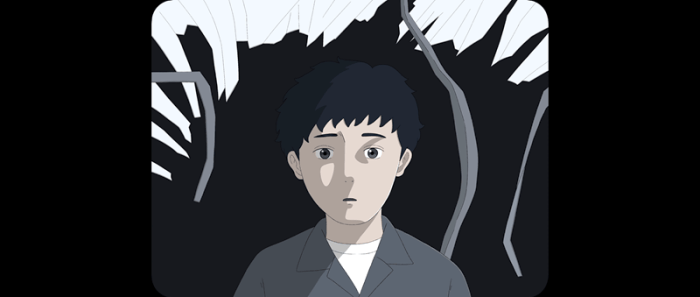
Still from Ryuya Suzuki’s JINSEI. Photo courtesy of Greenwich Entertainment.
Across 100 years, across multiple chapters of a single life, across several names and identities, our protagonist (voiced by ACE COOL) endures tragedy; the rise, fall, and rise again of a J-Pop idol; idolatry; war; and more in between. With each chapter comes a different perspective and question about the life led.
The following home release review is based on a Blu-ray retail copy provided by Kino Lorber.
According to the press notes, Suzuki created Jinsei (a word meaning “life”) across 18 months, his first feature after developing his first short, MAHOROBA, in 2021; followed by his second short, Lawless Love, in 2022. Though he intended to be alive-action filmmaker, he decided to teach himself animation in the early days of the COVID-19 pandemic, resulting in MAHOROBA. Through this lens, Jinsei’s quiet, existential nature makes a great deal of sense as it seeks to look at the internalized trauma of one repeatedly beaten down individual who seems desperate for connection and community, yet struggles with communication to the point that others often use him as an avatar for their own desires until he can draw enough strength to react or respond. This is often demonstrated by Suzuki through a repetition that occurs two or three times in the film in which the same cycle of events play out over and over. The featured characters and locations will differ based on the chapter we’re in, but the structure remains the same: posture, action, and figures — all looping. While montages such as these are often used to denote passage of time, even growth, here, the incorporation creates a dissociative effect wherein we, the audience, grow dull in response to the machine-like repetition. The protagonist is so perpetually silent, offering only the rare verbal response or physical action beyond his hyperfocus, that seeing these sequences tends to convey someone who is not actively engaged in his own life, merely riding it out.
Interestingly, the shifting visual ratios directly tie into the tale as our protagonist’s perception shifts — sometimes tied to his age (4:3 as a child, grows wider as an adult, reduces again in old age), sometimes to the scope of the tale (personal tragedy versus global war). The opening sequence, set in 1994, opens with the silent introduction of his parents (one a taxi driver, the other a client) and we watch how they meet, how they bond, and, eventually, fall in love before having the protagonist. After his birth, a locked perspective repetition loop takes us through the first tragedy that ultimately becomes the defining thing for him as he watches his parents get gravely injured by a distracted driver. The tightness of the ratio helps to convey the size of his world, the people within it, and the damage done in the absence of his birth parents. Even as he makes a friend in the form of Kin (voiced by Taketo Tanaka) in the chapter where the protagonist has the name of “The Grim Reaper,” the ratio stays tight because, as one might infer, his world remains small, compact, and crushing. He barely speaks, accepts a great deal of punishment, and exists in a world that’s designed to be as confining as possible. Conversely, the visual ratio expands as his place in the world also widens when he’s taken for a hero or an idol or mistaken for a deity, even if the protagonist doesn’t engage with it more than before. Here, the presentation of the ratio is a contrast to the stillness of the protagonist who, like everything in the world we observe, moves with rigidity or small articulations. Rather than being the center of ridicule as “The Grim Reaper” in childhood, he’s the gravitational pull for a religion that builds outward from him despite no indication that he wants this sort of life. Thus, even with the widened visual scope, Suzuki still generates a cold dissociative feeling as the world changes around the protagonist and he doesn’t care to engage (even if evidence suggests otherwise by the changes we observe). As simple as these animation choices are, they have a big impact on the way that the audience receives the persistent and continuing tragedy of the protagonist’s lengthy existence.
Unfortunately, the physical edition of Jinsei includes no making-of materials whatsoever — nothing that explores the 18-month period it took Suzuki to develop the project, the inspiration for it, or the concepts of each segment. Perhaps this is intentional, leaving the esoteric elements to remain as such, totally interpretative to the audience and their experience. What home viewers are given is the 23-minute 2022 short Lawless Love and five trailers for other Greenwich Entertainment titles. Not exactly a treasure trove of on-disc materials, however, given the current landscape of physical edition availability, something is certainly better than nothing.

Still from Ryuya Suzuki’s JINSEI. Photo courtesy of Greenwich Entertainment.
Suzuki’s Jinsei is the kind of tale that works best, frankly, as an animated piece. It’s not that it couldn’t work with a live-action production, it just wouldn’t have the same resonance or ability to convey its dissociative elements which are critical to shaping its existential dread. Humans, even under the director of Wes Anderson, possess a certain flexibility despite their stillness. The animation allows for the characters to transform metaphorically without transmutating themselves, their stillness and stiffness becoming a part of how the protagonist sees the world in his way of making sense of a life filled with violence, degradation, lust, and greed. Even as the protagonist longs for self-expression, it’s all connected to an existence he could never have, making it a terrible longing, an absence he’ll never be able to fill despite any adulation he earns, a part of this world but remaining forever separate from it. Such is life, sometimes. And it hurts.
Jinsei Special Features:
- Lawless Love, 2022 short film
- Five (5) Greenwich Entertainment trailers
Available on VOD July 16th, 2026.
Available on Blu-ray and DVD August 18th, 2026.
For more information, head to the official Greenwich Entertainment Jinsei website.
To purchase, head to the official Kino Lorber Jinsei webpage.
Final Score: 3.5 out of 5.

Share this:

Categories: Home Release, Home Video, Recommendation, Reviews, streaming
Leave a Reply