
Over the last seven years, Chinese studios have tapped the 16th century Chinese novel Fengshen Yanyi (Investiture of the Gods) to craft stories in live-action (Creation of the Gods trilogy) and animated (Legend of the White Snake; New Gods: Yang Jian; Ne Zha). With each adaptation, audiences are introduced to colorful characters, fantastical adventures, and lessons in morality and ethics. Borrowing from a different source in Chinese mythology, writer/director Mu Zhengyang, in their directorial debut, offers a new quest in All Wishes Come True! (八仙!) featuring the mythological Eight Immortals, a gathering of thieves believed to have done such good works as to be bestowed the honor of immortality. Packed with action and hilarity wrapped in a confidence game setup, All Wishes Come True! manages to infuse a surprising weight, giving audiences an epic ride with a resonant intention.

Center: Lü Dongbin voiced by Li Shaozhe in ALL WISHES COME TRUE!. Photo courtesy of CMC Pictures.
When a protective charm for humanity goes missing, upsetting the balance on Earth, those who can retreat to Penglai, a place where mortals and immortals can coexist. There, Lü Dongbin (voiced by Li Shaozhe) searches for the charm, a lantern, which he knows has been reshaped into a different object by a renowned thief, Zhongli Quan (voiced by Chen Hao), and stored in the vault owned by the three gods who oversee Penglai. Reluctant to assist Lü Dongbin at first, Zhongli Quan acquiesces when a deal is struck that one can take the lantern while the other can take the riches inside the vault for himself. However, as the duo put their plan into action, a series of unexpected consequences result in the team of two transforming into a team of eight with every action holding far more in the balance than anticipated.
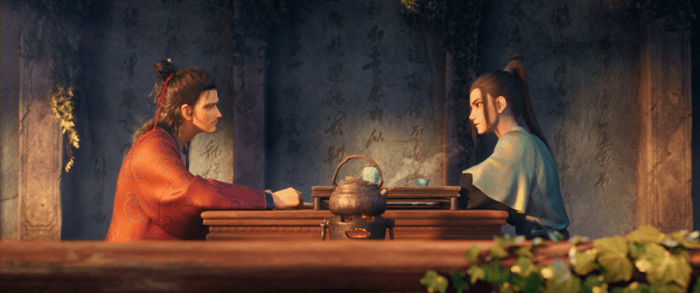
L-R: Zhongli Quan voiced by Chen Hao and Lü Dongbin voiced by Li Shaozhe in ALL WISHES COME TRUE!. Photo courtesy of CMC Pictures.
While less widely known in the U.S. than their Investiture cousins, the Immortals have been referenced or included in other properties over the years. Jackie Chan’s Drunken Master films incorporate influences from the Immortals (often known as “Eight Drunken Immortals”) and, reportedly, Chan would later portray a version of one of the Eight in The Forbidden Kingdom (with Jet Li as Sun Wukong, The Monkey King). Rather than kick things off with the group established, Mu’s adaptation of the story The Eight Immortals Cross the Sea serves as an origin story that creates a foundation for less-aware audiences as it does utilize what already exists to craft an adventure built from established lore. This is a tricky proposition for any filmmaker, let alone in a debut feature, yet Mu artfully threads the needle and it all begins with a singular choice — rather than use one of the Immortals to narrate the opening that establishes the world we’re entering, he uses one of the humans impacted by the absent lantern. It’s a small choice, but one with great ramifications going forward as a mortal setting the stakes means that what follows may as well be myth or legend. From the outside, it obviously is, but the framework of the opening allows a great deal of flexibility for the story that follows and Mu takes great advantage of this. For if one presumes that the stakes are as high as the introduction suggests and that immortals and gods are involved, then why not make Penglai as grandiose as possible while also crosswise of time itself? Why not make the characters a mixture of expected wuxia construction (ethical fighters striving to put virtue before all things) while incorporating lower-grade physical comedy? Why not blend period accurate boats and carriages with a Rainbow Road-esque travel system or a marble game that functions as a motion tracker? These little stylistic affectations are a way for the film to reach across time and tickle modern audiences through the seemingly anachronistic approximations of familiar things without breaking the story.
In terms of story, Mu’s approach is simple and, like the subgenre it borrows from, hides more than it initially reveals. For the bulk of the fantastical adventure, the premise is that of a heist comedy wherein each attempt by Lü Dongbin to recover the lantern grows more complicated by the moment. First in the acquisition of accomplished thief Zhongli Quan and then in the execution of Zhongli Quan’s plan which results in five more team members reluctantly being added because each is too smart to allow these two to just do what they’re doing without getting a piece of the action. For American audiences, this film is a bit of Ocean’s Eleven (2001) mixed with Confidence (2003) and The Italian Job (2003) — it’s a story of grifters and thieves coming together to pull a job that should be otherwise impossible while pulling off something else entirely in the process. In this case, it’s learning that being a thief doesn’t mean doing harm. In a flashback for Zhongli Quan, we learn that the school he attended taught the difference between doing what’s right and doing what provides personal gain. This is a message that’s universal in just about any tale in which a thief is centered and there’s a chance that the story won’t lean into darker areas of criminality (Thief; Heat). Why one steals matters as much as the act itself — which is why it’s hilarious when a constructed cover within Penglai turns profitable to the point that one even wonders why the team should continue their heist plan except, you know, MacGuffin and the greater good’s at risk. This ends up being a significant narrative theme that Mu deftly weaves into the action and comedy elements, first subtlety, and, later, less so, making the whole of All Wishes Come True! an adventure with an important message about cruelty and kindness, selfishness and altruism, and the sacrifices that come when making choices in either direction.
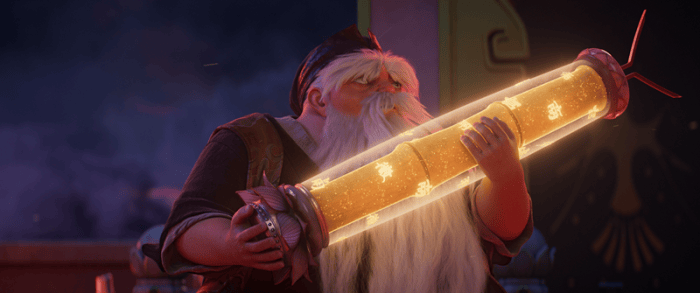
Zhang Guolao voiced by Deng Xiansen in ALL WISHES COME TRUE!. Photo courtesy of CMC Pictures.
Admittedly, All Wishes Come True! is not entirely for the uninformed with Chinese mythology and legends. The dialogue comes fast and subtitles move to match, there’s plenty to see through the wonderous animation from Pearl Studio (which means occasionally missing context from subs), a large ensemble cast with motivations to match, and, of course, not everything or everyone is fully explained. One particular moment requires knowing a bit about characters outside the Eight Immortals story who will not be explained fully, yet aware audiences will delight in its occurrence. Similarly, conscious audience members will be tickled by reference points that’ll have you gleefully giggling like you’re Po in the Sacred Hall of Warriors. None of this is a detraction on the film because it’s specifically constructed for Chinese audiences and it’s the film which is reaching out for international viewers. In the same way that Ne Zha 2 (2025) drew in audiences, so does All Wishes Come True! contain the same potential and maybe even generate enough curiosity that folks might pick up other adaptations and take the adventure further until a new Eight Immortals tale can be adapted — a possibility that is hinted via a credit scene

A still from ALL WISHES COME TRUE!. Photo courtesy of CMC Pictures.
Mu Zhengyang’s All Wishes Come True! seems to arrive at just the right time — a time when 145-minute superhero stories can break records, at a time when audiences are hungry for original stories, and at a time when folks are looking for something to take their young adult families to go see. It’ll feel fresh to American audiences, the incorporation of so many characters is handled with deftness so that the film sings along, and it incorporates stunning visuals with grown-up themes (and consequences) in a manner that never comes across as condescending. The film entirely trusts its audience to get on its wavelength and fast, allowing it to feel somewhat breakneck at times while never quite pushing the throttle so hard as to leave audiences behind. Couple this with clever confidence elements, a dazzling third act stunt sequence, and enough jokes to soften the weighted intention of the narrative, and you’ve got yourself a great reason to escape to the cinema.
In select U.S. theaters August 14th, 2026.
For more information, head to the official CMC Pictures All Wishes Come True! webpage.
Final Score: 4 out of 5.

Share this:

Categories: Films To Watch, In Theaters, Recommendation, Reviews
Leave a Reply