
In 1949, history was made with the debut of Wile E. Coyote and his enteral pursuant Road Runner in the Chuck Jones-directed (Hair-Raising Hare), Michael Maltese-written (Duck Amuck) Fast and Furry-ous. For seven minutes, audiences came to know the hilarity that is Wile’s persistence as he attempts over and again to capture Road Runner in order to sate his hunger. As the decades have gone on, conventional concepts for capture have given way to ACME products, the official purveyor of anything any Toon needs in any Looney Tunes tale, making Wile’s attempts — as well as their failures — all the more impressive in scale. Each time audiences laugh at the pain Wile and his fellow Toons experience in their latest adventure, the hilariously daffy Coyote vs. ACME, directed by Dave Green (Teenage Mutant Ninja Turtles: Out of the Shadows), is a bit of life imitating art, and the narrative tackles this directly. Borrowing from All the President’s Men (1976) and Looney Tunes: Back in Action (2003) in equal measure, Coyote vs. ACME posits that a lifetime of laughs comes at a high cost and none should be ok with the status quo, regardless of how animated they are.

Wile E. Coyote in COYOTE VS. ACME. Photo courtesy of Ketchup Entertainment.
Upon the latest and most spectacular failure to capture the Road Runner (voiced by Eric Bauza), Wile E. Coyote returns to his cave to devise another in a long, long, long, long, long, long, long line of attempts when he catches an advertisement for the law office of Avery, Jones, and Maltese offering litigation support for those who have been harmed by ACME. However, when Wile shows up and tries to hire Kevin Avery (Will Forte), the two quickly realize that they have different ideas for how to pursue the giant corporation, but a challenge has never stopped Wile and he eventually gets his way. Unfortunately, what neither realizes is that catching the Road Runner might be the easer of the two challenges as taking on ACME means battling more than legal opposition Buddy Crane (John Cena), it means going against a too-big-to-fail institution.
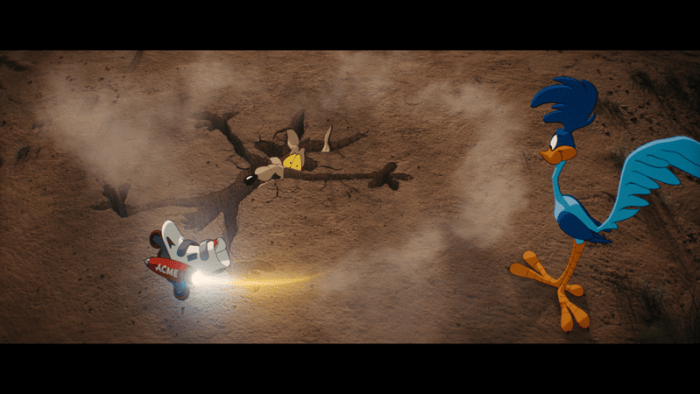
L-R: Wile E. Coyote and Road Runner voiced by Eric Bauza in COYOTE VS. ACME. Photo courtesy of Ketchup Entertainment.
For the uninformed, Coyote vs. ACME is the film that almost wasn’t as Warner Bros. Studios head David Zazlav tried to dump the film for a tax write-off. That’s why distributor Ketchup Entertainment (in the second time they’ve rescued a WB Animation Looney Tunes project) has advertised this with a wink and nod as “the movie ACME doesn’t want you to see.” In that light, Coyote vs. ACME has a number of surprises best kept to discovery on a fresh watch, so the following review will strive to be as spoiler-free as possible, only referencing anything made publicly available through press materials like film stills, video teasers, or film trailers.
Written by Samy Burch (May December) from a story by James Gunn (Superman; Scooby-Doo), Jeremy Slater, and Burch based off a similarly named 1990 Ian Frazier The New Yorker article, Coyote vs. ACME is both a unique Looney adventure and a beautiful extension of ideas explored in the mixed-media marvel that is Who Framed Roger Rabbit (1988). In that film, the Toons represented the Black community as secondary citizens in 1930s Los Angeles whose entire way of life provided enumerable profits for the studios yet were given no loyalty when it came time to make changes. In the case of Roger Rabbit, that film borrowed from the real L.A. freeway plans that purposefully chose lands impacted by redlining to determine where construction would take place. There was no dip used in this instance, just old-fashioned utilization of the legal system. So, in Coyote vs. ACME, when Buddy states to an unnamed voice on the phone in his very first scene before he’s added to the primary plot that what they do is legal because they write the laws, it’s both a gag to clearly identify Buddy as an antagonist for Wile and Kevin *and* to signal just what kind of villain he is to the audience. This is someone who sees anything as legal to be defined not by what’s moral, just, or correct, but by what influence determines is allowed. This is the defining trait for Coyote vs. ACME — the comedy is derived from the very real and current issue of companies, corporations, CEOs, and, generally, people in charge having absolute disdain for the people who use their products and/or services as we’re in their way on their quest for greater financial gain or political control. This might seem like a reach and I can hear the complaints now — “It’s a family comedy; why are you putting politics into it? Just enjoy a Looney Tunes adventure and shut up.” — except the script from Burch directly addresses this in its semi-court room dramedy as it transforms Bugs into a Deep Throat-like character in the film’s second trailer. There’s a conspiracy afoot and it’s the kind in which ACME is the direct center by the way it believes itself too large to be defeated.

L-R: Will Forte as Kevin Avery and Wile E. Coyote in COYOTE VS. ACME. Photo courtesy of Ketchup Entertainment.
Perhaps the most fascinating element of this concept is the choice to make Foghorn Leghorn (voiced by Eric Bauza) the CEO of ACME. He’s not the first Toon-turned-antagonist. Marvin the Martin (voiced by Eric Goldberg) partnered with Looney Tunes: Back in Action’s Mr. Chairman (Steve Martin), while the Weasels worked alongside Roger Rabbit’s Judge Doom (Christopher Lloyd). The story is going to use whomever the writer(s) feel is best for the part and Leghorn perfectly encapsulates the weaponization of “down home country charm” that will smile in your face while stabbing you in the back and the profiteer who doesn’t care where the money comes from as long as the profits don’t stop, justifying all manner of cruelty as being worth the savings to shareholders. Specifically, there’s Wile who, after 77 years, has been dragged, exploded, crushed, shaved, and more for audiences’ enjoyment and all because ACME products fail time and again. Wile’s pain is our delight as he tries unendingly in his Sisyphean quest to consume the Road Runner. He’s also a Toon, just like Leghorn, and, yet, Wile’s protracted physical misery is viewed as “the cost of doing business” when no permanent harm can come to Wile. That perspective is analogous to real-world events wherein the people who make products don’t care about whether or not their customers live or die, just whether or not the product is sold and profit is made. Consider the case of “swill milk” that utilized (among other things) chalk to disguise the color of milk gone bad in the 1800s. Or the recent issue of Taylor Farms being protected by the current White House for their contaminated foods (greens and fruits) which have contributed to the cyclospora outbreak. Some would say that regulations put a vise on innovation and only raise costs for consumers, but history indicates that if a company can cut costs regardless of impact to consumers, they’ll do it and then blame regulations for any negative effect. For decades, ACME has represented a faceless corps whose mission is to supply only the looniest of products to its customers, but, what Coyote vs. ACME asks is whether or not this is all happenstance (a by-product of the daffy failing to use a product according to design) or if the failure is the design itself.
No wonder David Zazlav wanted to shelf the film for tax purposes believing this film not to be financially ideal. This title might hit a little too close to home for the studio head who can’t seem to understand that he’s in the business of entertaining people and not serving shareholders. Of course, you need successful films in order to make a profit so as to make the next one, but profit isn’t the lone goal of moviemaking. Making the art is the goal. If one takes the Leghorn/Crane view, then releasing any old cinematic swill (Insidious 47; The Lord of the Rings: The Hunt for More Money) is fine as long as people buy tickets. Projects like Sinners (2025) or One Battle After Another (2025) become the exceptions when not tracing the same template should be the rule. Thus, audiences find themselves in a precarious situation in which they must decide for themselves whether or not they want the business to continue on only established IP titles, only original features, or as a mixture of the two, which is what has gotten it this far. Folks like Zazlav are included here because the constituents he serves are the audience members, not shareholders, who are just profiteers on the backs of the Toons, screenwriters, craftspeople, and filmmakers. When one starts focusing on the profit margin and not the ingenuity, the purpose of movies gets lost. It’s the inspiration, the imagination, and the outright ability to see the world through the unique perspective of the artisans who create — whether in live-action or animation. Making movies is a lot like Wile in this way. It’s a losing proposition nearly every time, a gamble of one’s time and energy but, when it pays, it pays big time. When it doesn’t, like Wile, folks take what they learned and try again — over and over until they get it right.
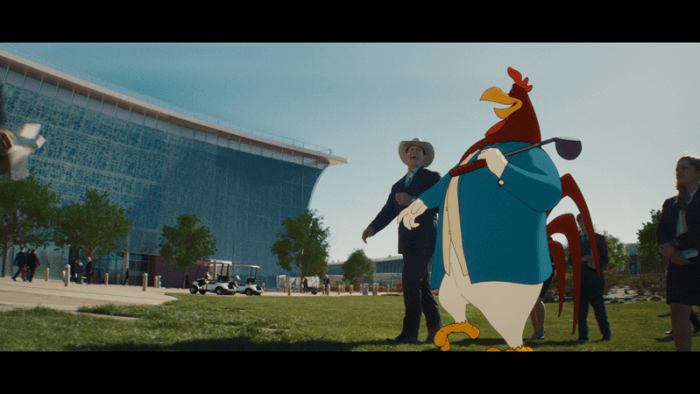
L-R: John Cena as Buddy Crane and Foghorn Leghorn voiced by Eric Bauza in COYOTE VS. ACME. Photo courtesy of Ketchup Entertainment.
This isn’t just rhetorical or academic stretching. Green and Burch pull from decades of Loony Tunes cartoons whether through riffs on dialogue, musical cues, placing commonly paired characters together, or straight-up using footage from the released stories prior. Unlike Back in Action or Roger Rabbit, which positioned the Toons as performers, Coyote vs. ACME gives them a different and distinct role within a society that doesn’t blink at the inclusion or action of any Toon. The pulling together of such works establishes a specific sandbox for the characters that not only creates a breeding ground for the looniest antics you’ll find in the theater, those antics are designed to function on multiple levels (as a gag or something deeper). To that end, delight in knowing that the transition from 2D to 3D animation does build on the modern WB Animation era of Looney Tunes without losing what makes each character distinct. Likewise, the assembled cast plays things so straight regardless of the circumstance, it makes all the things the Toons do even funnier.
How could anyone watch Cena (Heads of State; Peacemaker) say “I don’t pay you to tink you taw. I pay you to taw. What did you tee? What did you taw?” with a straight face to Tweety Bird and think this film wouldn’t draw an audience?

L-R: Lana Condor as Paige Avery, Wile E. Coyote, and Will Forte as Kevin Avery in COYOTE VS. ACME. Photo courtesy of Ketchup Entertainment.
While the film itself may not have enough nonstop madness to hold the attention of young audiences, young adults and older are going to have a blast with Coyote vs. ACME — especially those who grew up saying “That’s All Folks!”. It’s smart and funny while also sharply diabolical in its satirical commentary on the times. Most impressively, it comes off as entirely hopeful as it never forgets that just because one is a little looney doesn’t mean that one doesn’t deserve their tenacity acknowledged and how that’s a skill any one us can benefit from acquiring and honing. Just because one spends their time pushing a boulder up a hill, never reaching the top, doesn’t mean we shouldn’t try all the same. And just because a corporation says they’re too big to fail doesn’t mean we shouldn’t try to shut them down. Be Wile. Fight the fight that’s worth fighting, not just the ones you know you can win.
In theaters August 28th, 2026.
For more information, head to the official Ketchup Entertainment Coyote vs. ACME website.
Final Score: 4 out of 5.

Share this:

Categories: Films To Watch, In Theaters, Recommendation, Reviews
Brings a tear to my eye we get to see it, and it turns out to be as good as Forte and others claimed it was 😀