
Paul Newman is considered by many to be one of the best actors of his generation. His charm, humor, and dramatic heft in films like Butch Cassidy and the Sundance Kid (1969), The Sting (1973), and The Verdict (1982) are one of a kind. There is one film in Newman’s filmography that redefined audience expectations: 1963’s Hud. Adapted from Larry McMurtry’s novel Horseman, Pass By, the story follows rancher Homer Bannon (Melvyn Douglas), who deals with his unhinged son, Hud Bannon (Paul Newman). When Hud’s nephew Lonnie (Brandon de Wilde) arrives in town, Hud takes Lonnie under his wing, showing his nephew his destructive tendencies in the process.

Paul Newman as Hud Bannon in HUD. Photo courtesy of The Criterion Collection.
At the time of its release, Hud was a revelation of character-driven dramas. Newman’s performance completely subverted what audiences expected. Hud is vile, repulsive, rude, crude, and yet devilishly charming. Newman’s infectious performance makes one point incredibly clear as it’s easy to tell how every person he’s come across has fallen under Hud’s spell. The ability to switch personas, from vile to charm, is no easy feat for an actor to accomplish. An actor of Newman’s caliber knows how to play the grace notes of the character. No matter the cruel things he says or the charm he exudes, it is difficult to take your eyes off him.
Another credit to the power of Newman’s performance has to go to both the direction and screenplay. The screenplay by husband-and-wife duo Irving Ravetch and Harriet Frank Jr. wisely sets up the film as a showcase for Newman. This includes numerous dramatic sequences, allowing Newman to be unleashed on his co-stars. That is where my minor issues with Hud unfortunately take fruition. The supporting characters are not given dimensionality to make an impact. Actors like de Wilde (Shane) and Patricia Neal (Breakfast at Tiffany’s) serve as nothing more than building blocks in the establishment of Hud’s destructive journey in the film. In the wrong director’s hands, that can make the experience fully one-sided. That is not the case with director Martin Ritt (The Spy Who Came In from the Cold), who collaborated with Newman on six different films ranging from 1958 to 1967. Hud was the fourth film in their collaboration, showing a comfort level between both the actor and director. Ritt knows the power and screen presence Newman exudes on-screen. That is particularly evident in Ritt’s filming of close-ups of Newman’s face. Whether in sequences where Hud is making someone swoon or is getting yelled at by Homer, Newman’s eyes tell a story. Which, in this case, is not just to show his charm or beauty on-screen.
In Hud, Ritt films these close-ups to show Hud’s vulnerability and rage. The character is undoubtedly a charmer, but hides so much pain behind his eyes. It’s a captivating use of Newman, exploiting his assets as a performer. For a character-heavy drama such as this, and a lead performer of Newman’s caliber, the results are a powerful combination. That attention to craft and detail is particularly evident in this 4K Criterion home release.
Hud’s monochrome black-and-white 4K transfer offers a truly visceral viewing experience. Besides the sweeping vistas in this neo-western, the transfer’s crisp close-up shots are one of a kind. That is not even accounting for the bonus features on this 4K release. These features include audio excerpts from an interview with director Martin Ritt at the American Film Institute (AFI) in 1974, an interview with actress Sally Field (Smokey and the Bandit) regarding the film, and another interview with Roger Deakins (Blade Runner 2049) discussing the work of Hud’s cinematographer James Wong Howe (Fantasia). Those are enjoyable featurettes, but two in particular stand out. This 4K release includes an over-40-minute 1994 television episode of “Inside the Actors Studio” with Paul Newman and James Lipton. While this episode is more of a career discussion (with Hud being mentioned), the interview is a fascinating analysis of Newman as a performer. The other highlight from this release is a booklet that includes an essay by film scholar Gabriel Miller on Hud and an American Cinematographer interview with Howe. Both are great analyses of the nuances of Hud, allowing audiences to think about the film from new perspectives.
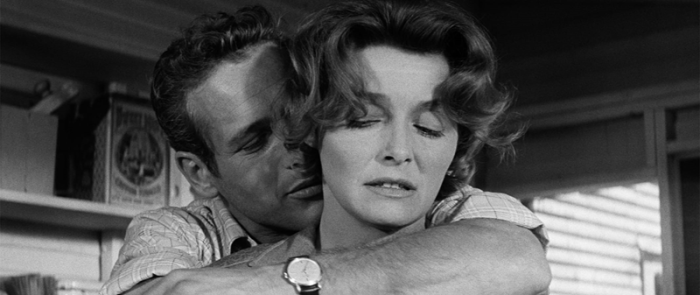
L-R: Paul Newman as Hud Bannon and Patricia Neal as Alma Brown in HUD. Photo courtesy of The Criterion Collection.
Hud exists as a revolutionary film for its time. The film is a neo-western about an unlikable man without much humanity. It’s an audacious narrative choice that would not work without a performance like Paul Newman. Some will consider the pace languid, but it’s the film’s subtle nuances that leave an impact. For diehard film fans, this purchase is a no-brainer. The special features may not be as in-depth as fans may hope, but the film as a whole is worth a purchase. For a casual viewer, Hud may not be worth a full-price purchase, but at an on-sale price, it would be well worth your time.
Hud 4K UHD Special Features:
- *NEW* 4K digital restoration, with uncompressed monaural soundtrack
- One 4K UHD disc of the film presented in Dolby Vision HDR and one Blu-ray with the film and special features
- Audio excerpts from a 1974 American Film Institute seminar with director Martin Ritt
- *NEW*interview with actor Sally Field, conducted by author Isaac Butler, on Ritt and Hud
- *NEW* interview with cinematographer Roger Deakins on director of photography James Wong Howe
- Episode of Inside the Actors Studio, hosted by James Lipton, featuring actor Paul Newman
- English subtitles for the deaf and hard of hearing
- PLUS: An essay by author and film scholar Gabriel Miller and a 1963 American Cinematographer interview with Howe
- New cover by Eric Skillman
Available on 4K UHD and Blu-ray July 14th, 2026.
For more information, head to the official The Criterion Collection Hud webpage.

Share this:

Categories: Home Release, Home Video, Recommendation, Reviews
Leave a Reply