
Photosensitivity Warning: Several scenes in Scarlet may prove triggering for photosensitive viewers through the use of stylized lightning. It occurs a handful of times in the film and can often be predicted, enabling a viewer to shield oneself, but it’s still good to be vigilant.
“I am but mad north-north-west. When the wind is southerly, I know a hawk from a handsaw.”
– Hamlet in The Tragedy of Hamlet, Prince of Denmark
The story of William Shakespeare’s Hamlet is well-known, even if the inspiration is oft debated. It’s viewed as a simple tale of bittersweet revenge, an adaptation of the Scandinavian tale of Amleth, and as born from Shakespeare’s own grief at the loss of his son, Hamnet. Whatever origin story one acknowledges, its legacy is cemented, performed throughout the world in classrooms, on stages large and small, and in theater houses. (Even, from time to time, in my own home when feeling whimsical.) Shakespeare’s tale is one of duty and honor, of a son called by the spirit of his dead father to avenge his murder and restore order to the kingdom, that ends entirely in tragedy because, as attributed to Chinese philosopher Confucius, “Before you embark on a journey of revenge, dig two graves.” This is the starting point for filmmaker Mamoru Hosoda (BELLE; Summer Wars) in his animated adaptation of the work, Scarlet, which utilizes the Shakespearean framework to view the concept of revenge through a different lens, questioning the validity of such a course of action and its impact on both the person charged with the mission and the world at large.

King Amleth voiced by Masachika Ichimura in SCARLET. ©2025 STUDIO CHIZU. Photo courtesy of Sony Pictures .
Toward the end of 16th Century Denmark, King Amleth (voiced by Masachika Ichimura) is beloved by his kingdom and his daughter, Scarlet (voiced by Mana Ashida), for the way he pursues peace, thus bringing prosperity to all. What Amleth doesn’t realize is that his brother, Claudius (voiced by Koji Yakusho), prizes both Amleth’s wife, Gertrude (voiced by Yuki Saito), and the crown, and is willing to do dastardly things to get them both. When Amleth is killed and Claudius is placed on the throne, Scarlet begins a plan of revenge that takes her to the mysterious “Otherworld,” a confusing land where past and future exist simultaneously and the key to exacting her revenge resides. But as she traverses the Otherworld and meets Hijiri (voiced by Masaki Okada), a paramedic from the present-day, her notions of justice begin to shift and she reexamines her mission for revenge.

Scarlet voiced by Mana Ashida in SCARLET. ©2025 STUDIO CHIZU. Photo courtesy of Sony Pictures Classics.
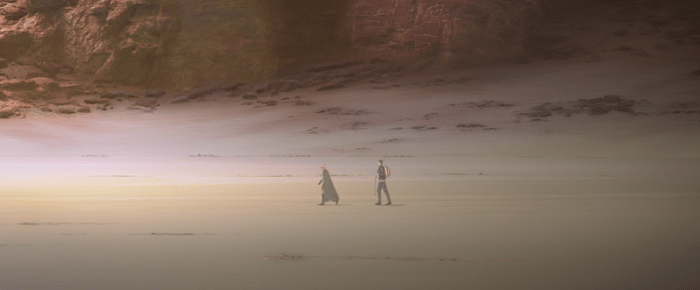
If one is familiar with Hosoda’s past work, one can see the transition and incorporation of digital animation plainly beginning with its most prominent use in 2009’s adventure rom-com Summer Wars with the natural realm being traditionally animated and the online world of OZ being computer-generated. This creates an immediate and clear delineation of each narrative space and the rules within it. Hosoda would do this again with 2021’s BELLE, a recreation/adaptation of the Beauty and the Beast tale, similarly using traditional animation for the natural world and CG for the online world U, once more serving the same purpose of separating the world. With Scarlet, Hosoda mixes computer-generated 3D and traditional animation so that a scene might incorporate both, this time conveying the overlapping nature of the Otherworld and the swirling time periods. To this end, in the introduction of the Overworld, we observe a harsh landscape of varying shades of red with scorch marks like aggravated veins in the ground all presented as if a matte painting, while CG clouds gracefully float above the scene. As we move to the ground, the animation comes alive, the violence suggested in the art and production design made realized as the form of Scarlet, dressed in a white gown adorned with white flowers, lays in a pool of red liquid as black-red hands rise up to pull her down. This violence is given additional weight through the 3D CG animation, the increased animation texture making the scene feel more authentic and, therefore, her danger more intense. However, having survived this encounter and traversing the landscape of the Otherworld, both portions of the landscape and the denizens oscillate between artistic styles. Which is to say that some characters, specifically those from Scarlet’s timeline that she’s on the hunt for, are CG animated, while others from different lands and times bear the impression of hand-drawn. This artistic choice highlights the unique rules of the Overworld which incorporate people of all places from all times; an artistic choice that makes the use of sword and arrow by some characters and gun-powder weapons by others normal in such a place. It also allows characters from Denmark to naturally engage with those from Japan or Hawaii Hawai‘i without breaking any specific rule that may take a viewer out of the experience.
L-R: Scarlet voiced by Mana Ashida and Hijiri voiced by Masaki Okada in SCARLET. ©2025 STUDIO CHIZU. Photo courtesy of Sony Pictures Classics.
Fascinatingly, the use of the two forms of animation works in concert with the themes of the film and its concept of the past impacting the future. One knows, for instance, that the choices of the past create ripples felt today, but one tends to only think of the negative choices and their reverberations. Hosoda’s tale, through the Overworld and two forms of animation, seems to convey that the differences between our tools and our lives are negligible with harmony possible when the effort is made. Soon after Scarlet and Hijiri met and somewhat begrudgingly travel together, they come upon a convoy that gets assaulted by not one, but two sets of bandit raiders. The timing of the attack draws out a laugh in the same way other films might use a series of beasts getting eaten by a sequence of larger beasts do, while also demonstrating the dangers of a place and the sort of ecosystem present. So not only does Hosoda present the violence of the Overworld, but, through the introduction of the convoy, how some struggle to trust, yet, through taking the chance on trust, are able to build an inclusive village of support. The people of the convoy are from different places and times, yet each find solace in the other. While the audience can visibly tell which style of animation is being used for which character as Scarlet and Hijiri engage with them, we, the audience, start to acclimate to the differences and just see people. This is the heart of Hosoda’s adaptation which challenges the expectation of a Hamlet adaptation by questioning whether revenge is the thing that Amleth would want or if it’s the selfish act of a hurt child?

Claudius voiced by Koji Yakusho in SCARLET. ©2025 STUDIO CHIZU. Photo courtesy of Sony Pictures Classics.
For the purists, Scarlet may feel like a shallow approximation of Hamlet. It utilizes several the characters from the play, riffing on their scripted personalities and making choices that fit the interpretation, but this is not Shakespeare’s Hamlet. Far from it and it’s all the better for it in the way it deviates. In the subtle way that Shakespeare informs us of the tragedy that it is to chase revenge, Hosoda places the quandary front and center, insisting over and over that the proper form of resistance to tyranny is compassion and forgiveness, beginning with the self. Much in the same way that Hamlet is not responsible for the death of his father yet is weighted by the guilt of it, so is Scarlet and the most radical act she can do is realize that her responsibility first is to herself and then to her people. Killing Claudius is a personal act, not one that serves the people, even if his removal would lessen the weight of his own tyranny upon them. Rather, Hosoda explores how choosing peace is the hardest decision one can make and, if one can maintain the course, then tensions the world over may well be reduced, potentially leading to less unnecessary death or murder. It’s optimistic and, in light of world events, possible fool-hearty, but when fools sit on thrones, the greatest form of resistance is art, is peace, is forgiveness. Not for them, but for each other, to ensure that our swords are pointed solely at those responsible and never at each other. That peace leads to prosperity whereas revenge leads only to destruction.
When the whole world is telling you that the enemy is everywhere, the best thing we can do is not listen and reach out our hand to help.
In limited release December 12th, 2025.
In select IMAX theaters February 6th, 2026.
In general theaters February 13th, 2026.
For more information, head to the official Sony Pictures Classics Scarlet webpage.
Final Score: 4 out of 5.


Share this:

Categories: Films To Watch, In Theaters, Recommendation, Reviews
Leave a Reply