
What is “happiness”? Is it freedom; the ability to be your own boss? Is it creativity; the ability to pursue your vision at all times? Is it divine; to either consume whatever prey you like or see your enemies crushed before you as the lamentations of the women surrounding you? One could say that “happiness” is really whatever we want it to be. This is a core element of writer/director Amanbek Azhymat’s crime comedy Backstage Madness (Шерменделик карнавалы), having its North American premiere in the Horizon 2026 section of Fantasia International Film Festival 2026. Through a winding tale of vignettes, a singular story is told in which the spark of imagination is sought, internal beasts are battled, and the war for creative control against corporate vision is waged — it’s sometimes hard to see its point through the figurative trees, but, if you give it time, it all comes into sharp relief in the end.

Right: Bolot Tileberdiev as the screenwriter in BACKSTAGE MADNESS. Photo courtesy of Fantasia International Film Festival.
Arriving to discuss his latest script, the screenwriter (Bolot Tileberdiev) is told that his asked-for love story is crap (sight unseen) by his producer (Kuralbek Chokoev) and is tasked to write another story from scratch. But this time — a crime story. Oh, and he has to include employees of the studio who have contributed to the film’s production budget. Oh, and also financiers who have donated to the production. This is just how movies are made, the writer’s told, as he’s sent back to his office to construct a new tale. But forming worlds requires a spark of imagination that he feels he’s lost and the din of voices from the crowd of unused characters in his mind are growing louder by the moment.
Azhymat’s tale is a bit chaotic, but it’s far more organized and intentional than it may appear at first. Filled with violence and heart, the whole of the film is like if Pulp Fiction (1994), Four Rooms (1995), Leonor Will Never Die (2022), and The Draft! (2023) crossed with A Moment of Romance (1990) and The Shape of Night (1964). One can certainly view the feature as an amalgamation of other stories, which makes sense given a specific MacGuffin that appears late in the film, but that would be only if one were to focus on the story being told by the writer and not the story of the writer. Azhymat’s film is a film within a film that also incorporates the world of the writer. Rather than just telling a story about the writer struggling to create a script with the ever-shifting demands of their producer, Azhymat starts by inviting the audience into the writer’s mind, then gives us reality, then the world of the story the writer is crafting. Through these three lenses, Azhymat presents a madcap tale of creation ramming against the fickle nature of capitalism wherein art isn’t the point, financial gain is. Chokoev’s producer isn’t wrong that a successful film is able to fund the next feature (this is literally the business model for The Asylum), but the presumption that writing is simple immediately makes him the bad guy and likely why that character plays the crime boss in all the story chapters we see.
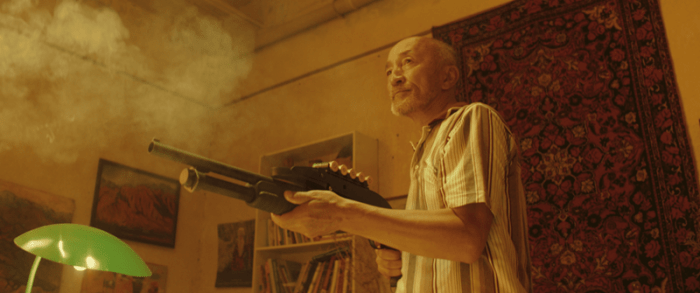
Bolot Tileberdiev as the screenwriter in BACKSTAGE MADNESS. Photo courtesy of Fantasia International Film Festival.
Fascinatingly, the film we watch being made is far less interesting than the story of the writer shown in significantly smaller portions. We watch as the script the writer is hammering out changes with each new addition, thereby altering/informing the course of the story and their sometimes differing tonal shifts. The film is a fairly rote as a crime story: a dime store tale of money owed, henchmen with their own desires, folks who just want to pay their debts, and those who want to keep others underfoot. Amusingly, the way that the story starts (a gigolo getting the raw end of his deal) is far more interesting than where it ends (a flurry of violence fit for a Quentin Tarantino feature or Elmore Leonard novel, complete with dark humor). But, one could argue, this is the entire point. It’s not that the film-within-the-film is bad, it’s that the creativity of the story is mired by the constraints of the producer, diminishing the ability of the writer to tell an organic, flowing story in favor of the demands made by financiers who want to be immortalized in celluloid. That push-pull is captivating and gives the film it’s tension, especially in the way that Azhymat manifests the writer’s creativity and the lengths he’ll go for inspiration (while feeling absolutely devoid of it). But this also means that the portions with the writer are few and the bulk of the 79-minute runtime spent on the film-within-the-film. Gratefully, the performances from the slowly-expanding cast are engaging with Azhymat side-stepping an easy comedic layup by making the financiers terrible actors and, instead, allowing the writer’s imagination make them exactly what’s needed to sell the story. In that way, one could even argue that the film we see isn’t even the film that the producer makes, it’s merely what the writer imagines.
To delve into the world of the writer, the primary lens of the film would, unfortunately, delve straight into spoilers that may ruin the fun and surprises within because Azhymat does intend to shake the audience right out of their expectations. It’s a clever vehicle for the film, a framework that allows the whole of Backstage Madness to go wherever Azhymat wants. Frustratingly, the total execution of the film doesn’t allow for the audience to spend as much time with the writer and his perspective as one might want, which, as a by-product, creates a tepid excitement for the film-within. The writer is the birth point for each story and this one is so long into his career that he’s haunted by all the stories he’s not yet told and the way that Azhymat manifests that causes one to lean-in with giddy excitement. It’s a shame, then, that the focus is so much on the film the writer is writing and not the process itself, which is far more appealing.

Center: Bolot Tileberdiev as the screenwriter in BACKSTAGE MADNESS. Photo courtesy of Fantasia International Film Festival.
Every movie watched required a great deal of work to get made. It’s a team effort from the director’s vision, to the craftspeople shaping the physical elements, to the actors breathing life into the world — but it always begins with the writer. They are the ones who “coalesce the vapors of human experience into a viable and meaningful comprehension” and that’s no bullshit. Whether adapting a work or shaping it whole cloth, a writer is the individual (or team) who must capture their imagination, tame it, and place it on the page in such a way that others can see what they see. No matter how many people may think so, writing is never easy. Certainly not as exertive an endurance trial as mass genocide or soccer, but it’s up there with the amount of energy required — and, yet, folks have a tendency to think that just having an idea for a film is enough to draft a script. This is the catalyst for Azhymat’s tale, showing the often-dire methods used by his fictional writer to gather inspiration while simultaneously combating the frequent interference of the creative process. Funny and sweet, while also bizarre and chaotic, Backstage Madness highlights the significance of the writer and troublesome journey to make art.
Screening during Fantasia International Film Festival 2026.
For more information, head to the official Fantasia International Film Festival Backstage Madness webpage.
Final Score: 3.5 out of 5.


Share this:

Categories: In Theaters, Reviews
Leave a Reply