
Trigger Warning: As a war film, there are obviously going to be presentations of conflict that involve physical violence. There is also a minor, yet significant storyline involving sexual assault that may be difficult for sensitive viewers.
Under the guise of battling communism, the United States supported South Vietnam in their civil war against North Vietnam and its allies, the then-Soviet Union and China, in 1955. The U.S. then ultimately pulled out in April 1975 when their efforts against the lower tech Viet Cong proved less effective. One of the tools used by North Vietnam were the tunnels of Củ Chi, part of an immense network of tunnels connecting significant parts of Vietnam that were used for communication, materials storage, assaults on enemies, and more. Having its North American premiere in the Horizon 2026 section of Fantasia International Film Festival 2026 is director/co-writer Bùi Thạc Chuyên’s Tunnels: Sun in the Dark (Dia Dao: Mat Troi Trong Bong Toi), a war film set during 1967 that presents the harrowing defense by several guerrilla fighters against U.S. forces. Shot with claustrophobic intensity amid harrowing circumstances and powerful performances, Bùi Thạc’s war drama conveys the human cost of conviction and the ways in which spilled blood never generates lasting peace.

A scene from the film TUNNELS: SUN IN THE DARK. Photo courtesy of Tunnels Film Company Limited.
Bay Theo (Thái Hòa) leads a group of 21 guerrilla fighters within a three-level section of the Củ Chi tunnels. Their latest assignment is to host a group transporting medical supplies; however, he’s told at the last moment that they are intelligence operatives working to capture incoming messages and pass information. Keeping this a secret from his unit is difficult enough with the ongoing bombardment from U.S. forces trying to sniff out members of the Viet Cong, but it’s made more-so with the recent arrival of possible defector Tu Dap (Quang Tuấn) and other disreputable discoveries made in the run-up to the final intelligence mission. Can the 21 hold the line or will they run out of time?

L-R: Hồ Thu Anh as Thu Anh and Quang Tuấn as Tu Dap in TUNNELS: SUN IN THE DARK. Photo courtesy of Tunnels Film Company Limited.
Written by Bùi Thạc (Glorious Ashes), Mỹ Uyên, and Nguyễn Thị Minh Ngọc (Song Lang), Tunnels is a surprisingly patriotic work, side-stepping nationalism by focusing on the efforts of fighters while incorporating the interpersonal aspects that aid in making the combat traumatic. It’s one thing to be conscripted to war, it’s another to choose to pick up a gun, grenade, or bamboo spear and face down an enemy. Through bits and pieces, audiences are given clues to who these people are as individuals separate from their fighting, slowly unearthing the humanity and pride within each one, as well as the cruelty that can arise from living in darkness. If Bùi Thạc only wanted to make a The Patriot-like (2000) tale, he’d only need to highlight the various ways in which the invading forces brutally attacked or took advantage of the Vietnamese, positioning the guerrillas as agents of prosperity; instead, the filmmaker uses the small group in this one localized place to present the complexities of the human experience in all its capacities for love and protection, as well as hate and harm, solidifying the notion that there were no purely good or purely evil fighting in war — just people. This is first represented by Bay Theo who leads the unit, serving as a father figure for all while being a literal father to at least one. Through Thái’s performance, Bay Theo is someone who understands that not everyone may make it out of their mission alive, that all of them gave up the absolute chance for survival by existing within this tunnel, yet he’ll do everything he can to ensure that they have some semblance of life. The character, as written, could be a formidable presence, and Thái offers a shape of Bay Theo that is looked up to and respected, yet we also see the person underneath who struggles with the weight of command and the harshness of doing the right thing always. Conversely, Bùi Thạc also incorporates the violence some women endured by their fellows, using the cover of bombardment to satiate themselves via another. This inclusion doesn’t reduce the female members of the unit and its depiction is brief and strangely chaste in presentation.
This being a war film, it’s important to note that the action is not put forward as a series of set pieces, producing conflict after conflict until the tale is done. Rather, the momentum of the film is pushed by three factors: the near-constant aerial raids by the U.S. military trying to seek out Viet Cong forces in the area, the secret mission and the ways it rubs against the work of the occupants, and an interpersonal conflict between Bay Theo’s second in command, Ba Huong (Hồ Thu Anh), and Tu Dap. As these three swirl around each other, the audience has a ticking clock via the mission, a perpetual sensory assault via the bombardment, and a reason to lean into the characters as questions of identity and loyalty are a matter of everyday life within the tunnels. By focusing on the characters and their relationships far more than centering the violence of war, Bùi Thạc is more easily capable of bringing the themes forward, as well as the patriotic message coursing throughout. None of the violence matters unless we care about the characters and we do grow to care, regardless of one’s perspective, solely because we’ve spent so much time with them, watching them grapple with their choices and the inherent violence they must adopt to survive, observing as they determine which parts of themselves are worth preserving and which they must abandon if they’re going to make it through.
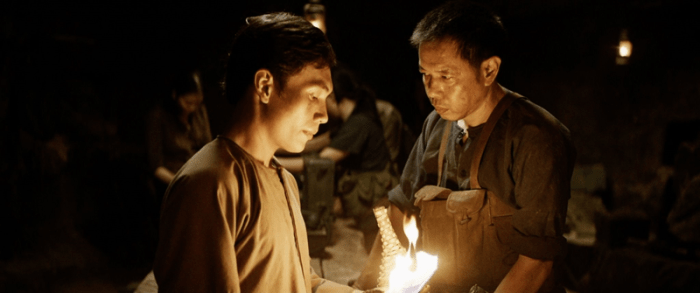
R: Thái Hòa as Bay Theo in TUNNELS: SUN IN THE DARK. Photo courtesy of Tunnels Film Company Limited.
The combination of K’Linh Nguyen’s (Glorious Ashes) cinematography and art direction from Mã Phi Hải (The Moon at the Bottom of the Well) and Le Van Thanh not only makes the history come alive in a realized fashion, but does so in a way that infuses the film with tension regardless of whether the characters are facing a bomb run or not. It’s an incredibly difficult task to naturally light a sequence, especially one designed to look underground, yet not only does the design and cinematography work hand-in-hand to do exactly this, the recreation makes one subconsciously shrink, twist, and crawl as the characters do. We can see only as far as the characters seem to and, when trouble inevitably befalls the tunnels (a Chekov’s Gun laid early when droplets of a nearby water source are seen in a lower part of the tunnel), the already tight enclosure shrinks even more, causing us to hold our breath in terrible anticipation. At the same time, even amid the muddy corridors, there is a richness in the colors (browns and golds in the lamp light) that communicates the aura of fortitude by the inhabitants.

A scene from the film TUNNELS: SUN IN THE DARK. Photo courtesy of Tunnels Film Company Limited.
In my house, we’ve begun to adopt a notion that “no” is the end of a conversation and “I don’t know” should be the start of one. Both are about trying to encourage curiosity, to inspire our children that knowing something doesn’t mean having all the answers and that not knowing something doesn’t make one weak or stupid, and that incuriosity is the true weakness because the world is vast and complex and only those with an insular worldview believe that they hold all the answers purely through the lens of their experience. A film like Tunnels: Sun in the Dark demonstrates the value of being curious, of seeing the world through a lens in which “the mighty” are the every-day, the people of the land, the ones who tend to take the first brunt of any military action (not the generals or defense leaders). A country is built by its people and its story told by those who survive, not just who win. Perspective holds value and the one within Bùi Thạc Chuyên’s film tells us that people are the real assets, that love triumphs through the propagation of a line, and that a well-placed snake or bamboo spear can do more damage than a several ton tank. History isn’t written by the victors, but by the memories conflicts leave behind. The trick is, as always, whether people are open to exploring it without jingoistic ego driving the pen that puts the proverbial ink to paper.
Screened during Fantasia International Film Festival 2026.
For more information, head to the official Fantasia International Film Festival Tunnels: Sun In The Dark (Dia Dao: Mat Troi Trong Bong Toi) webpage.
Final Score: 4 out of 5.


Share this:

Categories: In Theaters, Reviews
Leave a Reply