
It’s not unusual for an actor to write and direct, a director to write and act, or some other configuration of the three (and sometimes all at once on the same project). Being versatile not only permits someone to find ways to stay employed, it also aids them in better understanding the process of the respective position when working on other projects. One such individual is multi-hyphenate Jean-Pierre Mocky, who has done exactly this across several films through his career. In the month of June, Radiance Films is releasing two such Mocky titles on newly-restored HD editions: La tete contre les murs (1959) and Solo (1970). The latter, born out of civil unrest in France post-Mai ‘68, comes available for U.K. and U.S. viewers on June 23rd in the usual signature packaging with a small collection of archival materials that allow viewers, new and old alike, to gain a better appreciation for the crime thriller.
Upon returning from a work trip, violinist/jewel thief Vincent Cabral (Mocky) discovers that his younger brother, Virgile (Denis Le Guillou), may have been involved in a mass killing of socialites. Determined to find his brother and get him to safety, Vincent will travel in and out of Paris, navigating dogged police officers and suspicious anarchists in his quest. But will it all be for naught?
The following home release review is based on a retail Blu-ray copy provided by Radiance Films via MVD Entertainment Group.
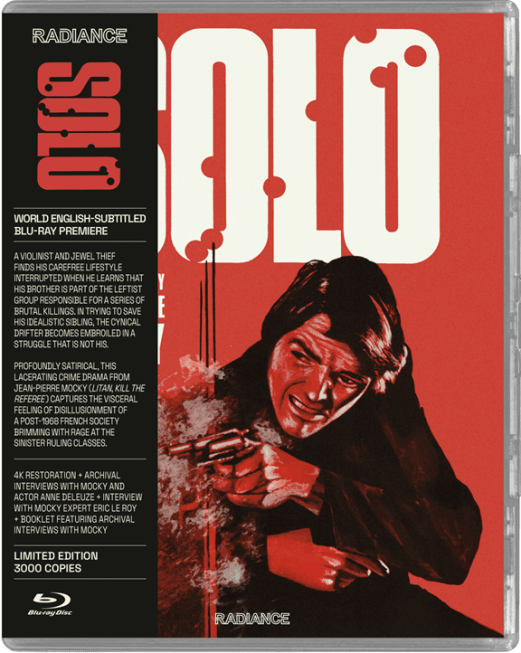
Moving outside in, Solo in this edition is limited to 3,000 copies, comes packaged in the standard clear case Radiance Films uses for their limited editions, and includes a booklet with essays and materials. The front has the removable OBI strip with release information so owners can opt to either keep that for reference purposes or remove it to provide a clean look for the front and back images. The front liner has a stylized version of the title and an artistic representation of Vincent firing a gun, while the back depicts Vincent in an awkward pose, police behind him (an image adapted from a scene in the film). The cover art is new in design, while the reverse borrows from the original poster art.
In terms of supplemental materials, this limited edition includes both the aforementioned booklet (with archival materials and cast, crew, and restoration information), three on-disc archival interviews, and an image gallery. The booklet includes two portions of interviews with Mocky — the first from “Jean-Pierre Mocky, The Maverick of French Cinema” from Daniel Geidreich (1970); the second from “Interview with Jean-Pierre Mocky” from Max Tessler (1970) — giving his specific perspectives from the era in which the film was made. These, along with the included archival video interview from Mocky for the previously-released ESC Editions DVD, offer a specific clarity of intention that time might alter in remembrance. Amid the usual still images from the film, a brief cast and crew listing is provided, as well as explanations on how this 4K HD restoration was developed. In this case, the restoration was executed by Éclair Classics and then a digital file was provided to Radiance for distribution. We are not given any additional details on the restoration process, however, one surmises that it may have been originally developed back in 2022 (as this is when the two “new” video interviews are from) and that Mocky’s estate approved the final restoration as Mocky Delicious Products is listed in the press materials as having supervised the development. The three interviews include one 13-minute video with Mocky from 2018 (he passed in 2019), a 17-minute video with actor Anne Deleuze (who played Annabal) from 2022, and a 15-minute video with Mocky’s former assistant and current Head of Collections at CNC Eric Le Roy. Each of these interviews were recorded for ESC Editions and are included here. Seeing as this is a first-time Blu-ray, and a 4K HD restoration at that, this may be the first time that these materials have been accessible in this format for U.K./U.S. viewers. Finally, there is an image gallery — it’s not an automatic carousel, but one which must be manually moved using the fast-forward or rewind button on the remote. Most of the images are film stills with the occasional poster, and each are marked with Die Brut der Gewalt, one of the alternate titles of the film.
Regarding the restoration itself, fans of film grain will delight that this specific texture remains intact, though primarily noticeable in daytime sequences. Otherwise, the image is quite pristine with little signs of wear. In the opening sequence in which the high society orgy is stopped by gunfire, skin tones of flesh are natural whereas the fake gunshot wounds, denoted by simple dots of red paint-like liquid, are vibrant and rich. One can really get a sense for how clean the restoration is when looking at the art gallery which includes a still from the police blocade sequence at night, which is demonstrably more defined in image quality and distinct in color contrast. The sound is, as expected from Radiance, clean and clear of distortion or other auditory imperfections. There’s one issue with the captions noticeably using the wrong word (“date” instead of “day”); however, they are otherwise fine in terms of consistency. (As I don’t speak French, I can’t comment on the accuracy.)
What’s fascinating about Solo is how it’s a response to the very real civil unrest that occurred in 1968 while still remaining quite relevant. For roughly seven weeks in 1968 France, spanning May into June, student uprisings against educational and governmental control resulted in a general strike in search of reform. Solo borrows from this, making the murders of members of high society at the start of the film an act of rebellion by the student class, who are angry at the shape of the world and the systems that uphold that society. These anarchists see violence as the only way to reform the status quo into something beneficial, unaware that destroying a few members only makes space for others (as expressed by the older and more world-travelled Vincent). Yet, even as one might find their methods for change extreme, as the cinematic world and real world collide – given that these mucky-mucks are partying with underage girls and the current revelation (no longer theorized) about the pervasive pederasts in the upper echelon of society – the elements within Solo cease to feel fictional or time-specific and the methods take on a slight enticing quality. The film is intended to be satirical, especially in the presentation of the police officers as operators for the wealthy and their relative disbelief that students could cause such violence (pinning things on Vincent when he enters their frame), yet it comes off as entirely truthful and honest in its characters so full of rage and disappointment at a nation unable to separate itself from the rot of humanity. It’s not so much that the film, and by extension Mocky as director, co-writer, and lead actor, supports violence as the only means of course-correction, but it does certainly make a case for the status quo requiring a shake-up, one in which those in power finally face the consequences they’ve been sowing so that the lower class and next generation can move toward improving lives instead of working toward selfish purposes. Between this thematic ideology and the dogged way Vincent hunts for his brother — getting ever closer to reach him, but never quite getting there — one finds themselves on the edge of their seat, hoping that the guilty pay and the dark hat justice warriors get away, if only in fiction.
With the ever-shrinking entertainment landscape due to media consolidation, distributors like Radiance Films do a massive service. They give you the chance to investigate cinema you might not have otherwise with film-enhancing special features within special packaging. You’re not just given the chance to own a film that can’t be stripped from you via deletion from the server or license expiration, you’re also given the chance for discovery and perspective expansion. Whether this is your first Mocky film, like it was for this reviewer, or a revisit, this edition makes the experience worth it, especially when weighing the interview materials newly-accessible to U.S./U.K. audiences. In this vein, this is an easy recommendation for any cinephile or crime-thriller enthusiast.
Solo Special Features:
- 4K restoration by Éclair Classics supervised by Mocky Delicious Products
- Uncompressed mono PCM audio
- Archival interview with screenwriter and star Jean-Pierre Mocky (2018, 13 mins)
- Interview with actor Anne Deleuze (2022, 17 mins)
- Interview with Jean-Pierre Mocky’s assistant and friend Eric Le Roy (2022, 15 mins)
- Image gallery with original promotional materials
- Optional English subtitles
- Reversible sleeve featuring designs based on original posters
- Limited edition booklet featuring archival interviews with Mocky
- Limited edition of 3000 copies, presented in full-height Scanavo packaging with removable OBI strip leaving packaging free of certificates and markings
Available on Blu-ray June 23rd, 2026.
For more information, head to the official Radiance Films Solo webpage.
To purchase, head to the official MVD Entertainment Group Solo webpage.
Share this:

Categories: Home Release, Home Video, Recommendation, Reviews
Leave a Reply