
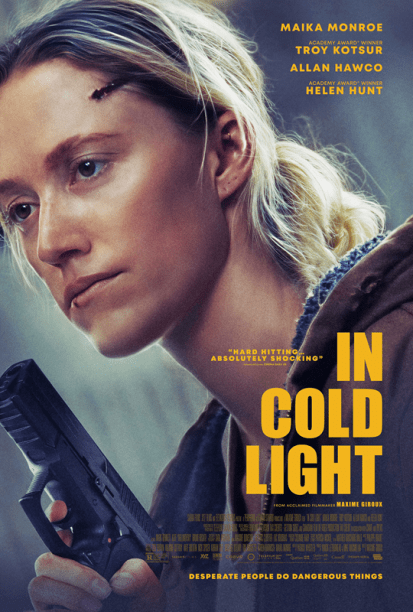
There’s a common misconception that stories, by nature of being broadcast or shown in a theater, condone behavior, justifying choices, always, simply because they are the behaviors and choices of the main character. This is an egregious failure of media literacy as the point of centering them may very well be to condemn the behavior, not uplift it. This, of course, then invites the argument over whether centering protagonists that commit hostile acts is actually glorifying them, creating a situation in which a misread occurs (see: Fight Club), but that’s not the point. What is, however, is the fact that the centering of tragic, broken, or even villainous characters is sometimes about exploring a side of humanity that’s worth investigating in order to garner empathy. This is a massive part of Maxime Giroux’s (Felix and Meira) new film, In Cold Light, fresh from its Tribeca 2025 world premiere and headed to theaters via Saban Films, as it centers a character driven by a responsibility unreasonably cast upon their shoulders which served as the catalyst for a series of self-harm events that culminate in a seemingly unrelenting violent night where all traumatic roads come to a head.

L-R: Troy Kotsur as Will and Maika Monroe as Ava in IN COLD LIGHT. Photo courtesy of Saban Films.
After spending two years in prison, Ava (Maika Monroe) heads home to reconnect with her twin brother, Tom (Jesse Irving), and get back to the drug business she ran. However, not everything is how she left them and, while she and her brother travel to a meeting, he’s killed and she’s framed for the murder. Now on the run, she has to figure out how to get clear of the charge and out from under the individuals who want her dead, but there’s a creeping inevitability that Ava can’t seem to escape no matter how hard she tries.

Troy Kotsur as Will in IN COLD LIGHT. Photo courtesy of Saban Films.
Written by Patrick Whistler (Dreamland), In Cold Light isn’t interested in holding your hand; it wants you to experience the story and think on it later. During the watch, one might find themselves struggling to lock in on a script so light on in-depth or concrete moments beyond the necessities. The lack of depth is intentional as we’re given only as much as our lead, Ava, is willing to give and Monroe’s performance makes it clear that she is locked down tight. Introduced before her prison sentence, Ava is metaphorically lost, depicted as upside down and falling as she rests in a field overlooking an expanse, high on a substance never identified through a vape-like device. Ava’s costumed with a red hoodie, small portions of her dyed-red hair peeking out, her face pale in the light, and her eyes somewhat unfocused upon being stirred by a phone call. Even after parole, when Ava is less tightly costumed, her hair now longer and more blonde, Monroe plays her as a tightly-wound coil whether it’s with Tom, her disapproving father, Will (Troy Kotsur), or either of her two former employees. Monroe is fire and ice with Ava, her performance making Ava barely able to mask her rage by a taut expression or movement. We don’t get long sequences of exposition or even characters saying things beyond the necessary partially because few want to risk Ava’s ire and partially because people don’t often info dump unnecessarily in real life, making the connection between Ava and the story difficult to realize and maintain. This can make the film seem incomplete, thin, and even, at times, rushed. Given some time to consider Whistler’s script, however, this seems to be a feature of the film baked right in, which may make it an acquired taste of a cinematic tale. In Cold Light is a slow burn in which the shedding of Ava’s layers comes at the cost of loved ones, her physical safety, and her sense of self, each sacrifice made on the way toward potential survival, each one forced out of her because there’s no other way to get this so-deeply-harmed character to open up. Monroe understands this, delivering a quiet, rage-filled performance that makes Ava someone we root for despite the perpetual screw-ups that occur.
One of the larger issues of the film is that it utilizes a great deal of style throughout, which may make the withholding of the narrative feel performative instead of connected. The flipping of cinematographer Sara Mishara’s (My Salinger Year) work so it appears that the laying Ava is resting amid a crashing Earth, starbursts on all the lights during the elongated night sequence that starts just before Tom’s murder. Sequences that are meant to evoke déjà vu or memory or other similar sensations can also be expressed as moments of dissociation, moments we’re invited to experience alongside Ava. These sequences function as a bridge between what can be spoken and what can’t with the terrible journey into proverbial hell being what forces Ava to confront herself. Interestingly, all the style choices and their convergence with the script never state that Ava is “bad” because of her drug habit; rather, they imply that Ava only has the drug habit, only got into distribution, because she felt she had no other options due to untreated trauma, trauma that neither she nor her family had the tools or, it seems, the willingness to address it. With each new layer that is removed, the audience sees Ava not as a drug user, not as a dealer, and not as an ex-con, but as a daughter who’s made mistakes and who has had the rope of responsibility falsely tied around her neck for so long that shuffling off this mortal coil seems like the only true freedom with drug-induced bliss being the next best thing. While at times artistic in its representation of Ava’s dissociation, the film is never cold as a result, even if distant by design.

Maika Monroe as Ava in IN COLD LIGHT. Photo courtesy of Saban Films.
Choice and consequences. It’s something that rattles around in my psyche quite a bit, particularly as a parent. Good and bad, positive and negative, we make a choice and the consequence occurs. The important thing is to ensure that natural consequences are all that my children face so that they understand this as adults. Without this distinction, a different mental concept is born in which external punishment, parental isolation, and/or the abdication of youth before its time nestles and grows within, leading one possibly toward a destructive path. Within In Cold Light, this is a key component as Ava, through her terrible journey, comes to realize the burden she’s carried and medicated herself from and that it was someone else’s to carry. On the run from those who would do her harm, having witnessed the murder of her twin, Monroe portrays Ava as having lost the best part of herself, the only part worth care and affection. Even when the script and its execution don’t rise up to meet her, we can see what Monroe attempts to evoke, making us all the more pained for her as the narrative goes on, hurtling toward an ending that’s more satisfying thematically than it is narratively based on what we learn. Frustration abounds at first, however, given space to sit with it, this does feel, to a degree, the intention of Giroux all along, to move us as he moves Ava toward a disquieting truth: to heal, we must first forgive ourselves.
In theaters January 23rd, 2026.
For more information, head to the official XYZ Films In Cold Light webpage.
Final Score: 3.5 out of 5.
Share this:

Categories: In Theaters, Reviews
Leave a Reply