
Photosensitivity Warning: The scenes involving Angels and/or Angels battling EVA Units, which make up a significant portion of the films, almost always involve flashing lights. Be prepared before watching.
GKIDS Films gained home release control of Hideaki Anno’s polarizing and frequently devastating animated series Neon Genesis: Evangelion for North America in 2021 and immediately put out three physical media versions of the full series and its initial two feature films *and* digital versions. By this point in 2021, the first three films in the Rebuild of Evangelion series had already released with now-out of print physical editions ahead of the North American theatrical release of the final film in the Rebuild series Evangelion: 3.0+1.11 Thrice Upon a Time. Since then, GKIDS released a fabulous 4K UHD Blu-ray Collector’s Edition of Thrice Upon a Time and is now bringing Evangelion: 1.11 You Are (Not) Alone (2007) and Evangelion: 2.22 You Can (Not) Advance (2009) out of physical media perdition with brand-new Blu-ray editions that incorporate all the previously available bonus materials.
If you’re unfamiliar with You Are (Not) Alone or You Can (Not) Advance, here’s a quick reminder.

A scene in EVANGELION: 1.11 YOU ARE (NOT) ALONE. Photo courtesy of GKIDS Films. ©khara.
Evangelion: 1.11 You Are (Not) Alone
Tokyo 2015: 14-year-old Shinji Ikari (voiced by Megumi Ogata) is summoned by his father Gendo (voiced by Fumihiko Tachiki) to meet Misato Katsuragi (voiced by Kotono Mitsuishi), the head of operations for the defense project NERV, which Gendo heads. He’s called there as Gendo wants Shinji to take over as pilot for a mech Unit-01, joining the defense force that battles giant figures referred to as Angels — beings already responsible for two massive attacks on planet Earth. Desperate for belonging and approval yet perpetually melancholic due to a negative perception of self, Shinji goes along to get along, all while being terrified of dying in a war, something which his father seems, at best, ambivalent about. Alongside fellow pilot Rei Ayanami (voiced by Megumi Hayashibara), the two hold the line against the Angels, unaware of the larger machinations occurring behind the scenes both within and outside of NERV to bring about a third impact which institutes the Human Instrumentality Project.
If you’re familiar with the series, the events of You Are (Not) Alone take place roughly within episodes 1 — 6 of Neon Genesis Evangelion.

Rei Ayanami voiced by Megumi Hayashibara in EVANGELION: 1.11 YOU ARE (NOT) ALONE. Photo courtesy of GKIDS Films. ©khara.
Evangelion: 2.22 You Can (Not) Advance
After preventing the latest Angel attack from penetrating NERV, reaching the captured Angel, Lilith, and thereby kicking off the Third Impact, possibly destroying all of humanity, Shinji and Rei are joined by EVA pilot Asuka Langley Shikinami (voiced by Yuriko Yamaguchi), while new pilot Mari Illustrious Makinami (voiced by Maaya Sakamoto) remains at the artic Bethany Base. As Angel attacks escalate and dangers increase, Shinji, Rei, and Asuka must figure out how to work together or all of humanity is going to fall; however, what they don’t realize is that may be exactly what some are hoping for.
If you’re familiar with the series, the events of You Can (Not) Advance take place roughly within episodes 8 — 23 of Neon Genesis Evangelion.

Asuka Langley Shikinami voiced by Yuriko Yamaguchi in EVANGELION: 2.22 YOU CAN (NOT) ADVANCE. Photo courtesy of GKIDS Films. ©khara.
The following home release review is based on Blu-ray retail copies of both You Are (Not) Alone and You Can (Not) Advance provided by Shout! Studios for GKIDS Films.
Additionally, it’s important to remember that while the Rebuild series can be viewed on its own, especially because these versions represent the most current and updated iteration of Anno’s vision, these films are best appreciated after having watched the full series and original two features because the series as a whole, in my view, is best considered as a loop in which lead character Shinji Ikari finds himself continually living this experience over and over, each time things being reset due to his reaction/response/growth at the end of each iteration with the final story within Thrice being the one in which Shinji actually achieves peace of mind, clarity, and freedom. Satisfying as Thrice is as a conclusion to Rebuild, it becomes far more so with the awareness of his internal journey from start to finish despite the repetition of narrative events.
Made it this far? Congratulations! Let’s get into what these new editions bring with them and what’s carried over from the previous FUNimation editions. To keep things simple, let’s move outside in.

A scene in EVANGELION: 2.22 YOU CAN (NOT) ADVANCE. Photo courtesy of GKIDS Films. ©khara.
Both new editions are housed in a cardboard shell case similar in material to the Thrice Upon a Time 4K UHD edition. Much like the previous editions having their own style so as to more easily identify them, You Are (Not) Alone has an iridescent case with the title on the front and identifying information on the spine and You Can (Not) Advance is housed in an orange case with the same styling of title information. You Are (Not) Alone is harder to read as the text matches the iridescent material, whereas You Can (Not) Advance is easier to identify as all the text is in black ink against the orange color. These shell cases are not particularly sturdy, but they do create some individuality between entries. Additionally, prior to opening, there is a single information sheet on the back of the case, but it’s not attached in any way to the case. If you want to keep this sheet once opened, it will fit inside the shell case, but not the disc case.
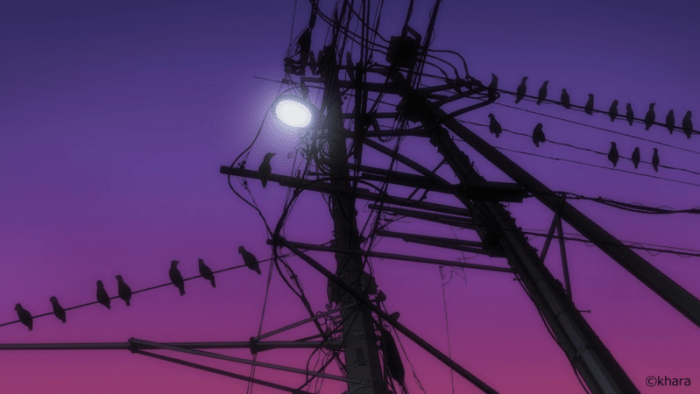
A scene in EVANGELION: 2.22 YOU CAN (NOT) ADVANCE. Photo courtesy of GKIDS Films. ©khara.
Within the cases is a single slim clear plastic case that houses the lone Blu-ray. You Are (Not) Alone borrows from the original FUNimation style with a liner that’s minimal in style, the front a deep red (possibly dark maroon) with black text on the front and nothing but black on the reverse side. Inside is an 8-page booklet with information on Evangelion, the Rebuild series, on-disc materials, film stills, sketches, and more with the cover and back pages mimicking the liner for the disc case. The general style and organization of the booklet is in-line with other recent GKIDS Films releases such as Thrice Upon a Time. The liner for You Can (Not) Advance is black with white text on the front and orange on the reverse. The 10-page booklet mirrors the logo design of the shell case in color and font with the interior matching the structure and general materials of You Are (Not) Alone — introduction to the series, character breakdowns, information on the bonus materials, and more. As I do have the FUNimation edition of You Can (Not) Advance, I can confirm that the booklet style in this edition does shift toward the GKIDS booklet style and does contain the same information just reorganized and with different images. The GKIDS edition of You Can (Not) Advance is far more minimal as it lacks Mari on the front liner, the sketch on the reverse side of the liner, and generally has a more conventional disc art presentation. In fact, both discs for You Are (Not) Alone and You Can (Not) Advance are identical in that they are both black discs with orange text for the film title and production credits.

Mari Makinami voiced by Maaya Sakamoto in EVANGELION:3.0+1.11 THRICE UPON A TIME. Photo courtesy of GKIDS Films. ©khara.
The differences between prior releases more or less stop here as the on-disc materials are essentially the same. There is a slight difference in the menu appearance and the loading screens, but the bonus features appear to be intact from FUNimation editions to the GKIDS ones. Research indicates that the FUNimation version of You Are (Not) Alone matches from one disc to another, while I have checked the discs for You Can (Not) Advance against one another. Additionally, there appears to be no difference between on-disc presentations of the GKIDS vs FUNimation editions. The biggest difference appears to be whether there are trailers for other release non-Evangelion titles included or not (GKIDS does not). So if you already have the FUNimation edition, you’re not going to get anything new here. This is mostly a benefit for fans of the series who have had no luck acquiring the Rebuild titles as these editions replicate the prior experience in a new package.

Shinji Ikari voiced by Megumi Ogata in EVANGELION: 1.11 YOU ARE (NOT) ALONE. Photo courtesy of GKIDS Films. ©khara.
As a physical media advocate, recommending these releases is fairly easy for those in search of them mostly because the Evangelion saga is beloved (painful as the films are to experience and explore) and that the first three films in the Rebuild series have either been out of print for some time or only available to stream. It certainly helps that GKIDS is taking the time to develop each release to have its own visual style in the packaging (putting their own style on the original individualistic style of the FUNimation editions) while also making sure to maintain the on-disc presentation and bonus features. While one can acknowledge that GKIDS is re-releasing these titles because they have the Evangelion saga under their purview and it would be ridiculous not to do this, it’s also abundantly clear that they aren’t just churning out a new version as a cash grab. Even if the packaging isn’t as sturdy as their BELLE collector’s edition or Masaaki Yuasa five-film collection they released, there’s still a clear understanding that thought and care went into these first two entries in the Rebuild series. This is what helps set GKIDS apart from other animated film distributors; they take into account the film material and the fans when constructing their editions.
In short, if you’ve been waiting to snag a copy of these two titles on Blu-ray, don’t wait any longer. Now to wait for Evangelion: 3.0 You Can (Not) Redo (2012) so as to have the full collection in one place.
Evangelion: 1.11 You Are (Not) Alone Previously Available Special Features
- Rebuild of EVANGELION: 1.01 (Shiro SAGISU version)
- Rebuild of EVANGELION: 1.01 (Joseph-Maurice Ravel version)
- Angel of Doom Promotional Music Video
- Theatrical Teaser 1
- Theatrical Teaser 2
- Theatrical Teaser 2
- Beautiful World Trailer A
- Beautiful World Trailer B
- Theatrical TV Spot A (15 sec)
- Theatrical TV Spot B (15 sec)
- Theatrical TV Spot A (30 sec)
- Theatrical TV Spot B (30 sec)
- Special Edition DVD TV Spot A (15 sec)
- Special Edition DVD TV Spot B (15 sec)
- Special Edition DVD TV Spot A (30 sec)
- Special Edition DVD TV Spot B (30 sec)
- Standard Edition DVD TV Spot A (30 sec)
- Standard Edition DVD TV Spot B (30 sec)
- Rental DVD TV Spot (15 sec)
- Rental DVD TV Spot (30 sec)
Evangelion: 2.22 You Can (Not) Advance Previously Available Special Features
- Rebuild of EVANGELION: 2.02
- Omitted Scene: C-0188A ~ C-0201
- Omitted Scene: C-0711 ~ C-0720
- Omitted Scene: C-0740 ~ C-0745
- Omitted Scene: C-0821 ~ C-0823
- “I Would Give You Anything” Scene NOGUCHI ver.
- Trailer
- Train Channel Spot
- Trailer for Yahoo! Japan
- Bluray/DVD TV Commercial A (15 sec)
- Bluray/DVD TV Commercial B (15 sec)
- Promotional Reel
- TV Spot A (15 sec)
- TV Spot B (15 sec)
- TV Spot C (15 sec)
- TV Spot D (15 sec)
- TV Spot A (30 sec)
- TV Spot B (30 sec)
- TV Spot (12 sec)
Available on digital September 16th, 2025.
Available on Blu-ray October 21st, 2025.
For more information, head to the official GKIDS Films Evangelion webpage.
To purchase, head to the official Shout! Studios Evangelion: 1.11 You Are (Not) Alone webpage.
To purchase, head to the official Shout! Studios Evangelion: 2.22 You Can (Not) Advance webpage.


Share this:

Categories: Films To Watch, Home Release, Recommendation
Leave a Reply