
If you’ve never heard of the Italian Napoleonic drama Allonsanfàn before today, don’t worry, almost no one has. I had not heard of it until Radiance Films announced this Blu-ray release, and one of Vulture’s film critics Bilge Ebiri quote tweeted, declaring it “One of the greatest of films, from two of the greatest directors who ever lived”, and reader, he might be right. If you had heard of the film before this announcement, then you probably read Michael Brooke’s February 2012 entry in Sight and Sound magazine’s “Lost and Found” series, highlighting lost treasures in filmmaking; the same Michael Brooke who lends his voice to this disc’s incredible critic’s commentary 12 years later. And now, you, too, can find this lost masterpiece, and, to be clear, I highly recommend you do.
Set post-Napoleon’s fall during the Bourbon Restoration period of 1815 Italy, Allonsanfàn follows Fulvio, played by Italian screen legend Marcello Mastroianni (8 ½, La Dolce Vita). Fulvio is an imprisoned leftist radical, a member of The Sublime Brothers. This is not a real group from history, but an amalgam pulling from many different revolutionary sects in Italy in the mid-1880s through the mid-1900s.
Attempting to solidify power after the ousting of the Austrian regime, the local government decides to release Fulvio, figuring that the suspicion his release will stir up the Sublime Brothers and will lead to infighting. And sure enough, Fulvio’s return is the start of the end of an era. Tonally akin to Stanley Kubrik’s (2001: A Space Odyssey) Barry Lyndon (1975), but shot more traditionally and on a smaller budget, Allonsanfàn is about being a radical in your youth and knowing you’re right, but realizing that you were born either too early or too late to enjoy political success in your culture. In this case, the naive Lionello (Claudio Cassinelli (Murder Rock, What Have They Done to Your Daughters)) was born 50 years too early to witness the Risorgimento, the political movement that sparks the reunification of Italy. Yet, only Fulvio has figured this out, and upon returning home to his aristocratic family, resolves to flee to America. But no matter what he does, The Sublime Brothers and their mission keep following him and involving him. As much farce as drama, the film’s comedic undercurrent brings in moments of magical realism and absurdity.
The power of the film comes from Fulvio’s personal relationships, as brother directors Paolo and Vittorio Taviani (The Night of the Shooting Stars, Padre Padrone) show us that political ideologies define our interpersonal relationships as they affect family, friendship, and community. Fulvio is married to another radical, Charlotte, played by Lea Massari (L’Avventura,The Meetings of Ana), and they’ve abandoned his son in the name of their mission. Now that he’s free, and reminiscing in his childhood bedroom, Fulvio wants to give that son the childhood he remembers so fondly, that of an aristocrat. The force that draws him from his radical beliefs into a facistical conformity is the nostalgia that comes for us all at middle age. The care he receives from his old servant, reminiscing about stories with his sister, memories of bedding his wife as a younger woman, this nostalgia born from the reflection of the middle-aged caught up with him when prison forced him to stop running from it, and now it’s become the prison on his shoulders, weighing down his every action. And his best friends, such as the trusting Lionello, have no clue what’s happening in Fulvio’s head. It’s dramatic and moving, but the dissonance between who Fulvio was and who he is becoming is ripe ground for entertainment as well. From infiltrating his own family disguised as a sickly monk to torturing his son with bedtime stories of a man-eating frog, Fulvio’s schemes are short-sighted and stupid, yet often successful for longer than they deserve to be.
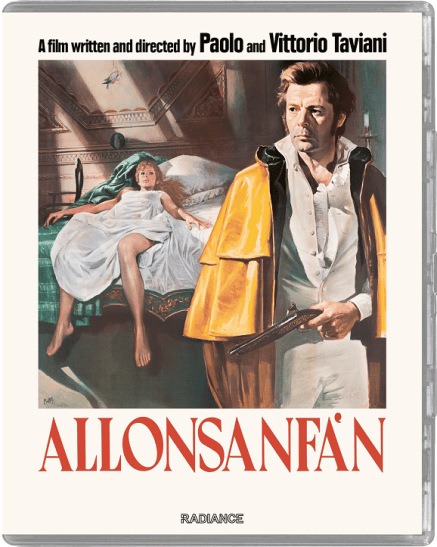
All you have to do is look at the cover of this release to feel its beauty and power. The front cover painting on the Radiance box captures the mood of Giuseppe Ruzzolini’s (Theorem, Firestarter) cinematography and Mastroianni’s performance perfectly. Throughout the film Ruzzolini often finds himself in red or yellow via a carefully planned through color theory by Guzzlini and the Tavianis. The red coat in a green field against a grey sky, the yellow coat in the darkness of seduction, color plays an immense part in Allonsanfàn, and it dances in the lens. The transfer, as usual, looks about as good as Radiance Films can get it, with the occasional stumbles one or two times in the coloration of low-light shadows, clearly being an aged print of poor stock, and not anything that can be fixed. Mixed in mono, the score was relentless, an instant classic for me. You’ll recognize some of it as well as the main theme by Ennio Morricone (The Thing; The Good, The Bad, and the Ugly), Rabbia e tarantella, makes an appearance at the end of Inglorious Basterds (2009).
What Radiance Films does achieve, is a pretty good box set. It’s not as feature-heavy as other Radiance releases due to its even more obscure nature than their usual stock and trade, but the booklet inside comes with a very good essay by Italian cinema expert Robert Lumley, as well as an archival interview with the Taviani Brothers from Jeune Cinema in 1975. Also included on the disc is an archival radio interview with the brothers where they pledge allegiance to truth at all costs, and reject the idea that the French New Wave had any thematic cohesion, insisting that it was instead an economic cohesion. As mentioned earlier, Michael Brooke, the critic who revived interest in the film via Sight and Sound all those years ago, gives the commentary for the film, and it’s well worth the price of admission.
Brooke’s commentary is a comprehensive analysis of this great film on a textual level, bringing his insanely detailed knowledge of Italian cinema to bear. It’s one of the best critic’s commentaries I’ve ever experienced. If it was recorded in a handful of live takes, then this is also the most impressive commentary ever, but if I had to guess, Brooke seems to pull off his non-stop monologue via detailed writing and editing. All listeners will gain a real education and many will wish they could listen at half-speed.
Politics happens to everyone, regardless of how “above it” they want to believe themselves to be. It’s an internal struggle this film confronts and one that it lost the battle to upon its release. It has rarely screened and has not found a cult audience in the United States, the chief theory being that the average American cannot identify with the radical leftist tradition of leaving your family behind and the trauma it brings. This is, of course, a stupid thought, because episode eight of season seven of The Simpsons (1989-Present), Mother Simpson, is one of the most beloved and powerful half-hours of American Television, in which Homer’s hippie-radical mother returns, and his internal life is painfully upended. That episode works because growing up means reckoning with who you’ve been, and that is a universal emotion at play in Mother Simpson just as much as in Allonsanfàn. I’ll never forget Homer sitting on his car, looking at an empty sky, just as I’ll never forget Fulvio standing alone in a field wearing that rebel-red coat. You will connect with this film, and, if you don’t, try again later. It’ll hit you then.
Is Allonsanfàn one of the greatest films of all time? I don’t know, maybe? I’m always of the opinion that a rating or a label given without the context of time to aid it is given in folly. That being said, that’s the gig, and we rate films here at Elements of Madness on a star scale, so I’ll let you know that it’s the easiest 5 stars I’ve given here yet, and that I’ll certainly be asking where it stands in the canon of history for a long, long time. Buy the disc as fast as you can, this is the only printing it’ll receive and it’s limited to 3,000 pressings.
Allonsanfàn Special Features:
- New 2K restoration of the film from the original negative, presented on English-subtitled Blu-ray for the first time in the world
- Original uncompressed mono PCM audio
- Audio commentary by critic Michael Brooke
- Archival interview with the Taviani brothers by critic Gideon Bachmann in which they discuss filmmaking approaches, the role of the director, the future of cinema and more (57 mins)
- Original trailer
- Newly translated English subtitles
- Reversible sleeve featuring designs based on original posters
- Limited edition booklet featuring new writing by Italian cinema expert Robert Lumley and a newly translated contemporary interview with the Taviani brothers
- Single pressing of 3000 copies, presented in full-height Scanavo packaging with removable OBI strip leaving packaging free of certificates and markings
Available on Blu-ray February 27th, 2024.
For more information, head to the official Radiance Films Allonsanfàn webpage.
To purchase, head to the official MVD Entertainment Group Allonsanfàn webpage.
Share this:

Categories: Home Release, Home Video, Recommendation, Reviews
Leave a Reply