
What does it mean to live an honorable life? Is it honoring yourself? Honoring your community? Existing by a code? These may sound like old-fashioned queries, the sort of things that warriors or soldiers asked themselves when written by poets, but questions like these help define our perspective. Filmmaker Kenichi Kutsuna’s jidaigeki tale Sekiro: No Defeat applies such questions through an adventure tale to assist audiences in processing them, perhaps to apply them to their own experiences. Adapted from the 2019 FromSoftware game Sekiro: Shadows Die Twice and having its North American premiere in the Animation Plus section of Fantasia International Film Festival 2026, Kutsuna’s Sekiro: No Defeat is a classically presented animated adventure exploring living with honor and dying with dignity that borrows from a variety of storytelling tools in order to create something unique, yet familiar.

Wolf voiced by Daisuke Namikawa in SEKIRO: NO DEFEAT. Photo courtesy of Fantasia International Film Festival. ©2019 FromSoftware, Inc. All rights reserved. ACTIVISION is a trademark of Activision Publishing Inc. All other trademarks and trade names are the properties of their respective owners. ©KADOKAWA/Sekiro: No Defeat PARTNERS.
During the Sengoku period, the last member of the Dragon’s Heritage line, young Lord Kuro (voiced by Miyuki Satou), is highly sought after by both the grandson of the ailing Ashina clan leader, Genichiro (voiced by Kenjiro Tsuda), and members of the Interior Ministry of Japan. Each of them want him for their own specific designs, specifically to strengthen their claim to the land, the former wanting it to remain in their clan while the latter wants to absorb it into Japan as part of the unification. Bound by both code and divine blood, the only means of protecting Kuro is his lone shinobi, Wolf (voiced by Daisuke Namikawa), who will do whatever he can to protect Kuro, even if it means gathering together sacred objects to sever the connection to the Dragon’s Heritage for good.
Originally released on Activision, the FromSoftware game Sekiro: Shadows Die Twice is a single-player action-adventure game for PlayStation, Xbox One, and PC that utilizes a story mechanic in which certain choices result in a different ending. Kutsuna’s adaptation, however, does not incorporate such an approach to the narrative, making choices that are final for these characters and this world. Perhaps that’s why Kutsuna’s adaptation, written by Takuya Sato, Kei Suezawa, Shunsuke Fukui, and Kutsuna, transforms the title, as well, hoping to further delineate the difference between the source material and this film. There’s an intentionality in the titling, one that draws straight from the third act of the film and ties directly to the essence of a character, whereas using the original game title doesn’t seem to have the same direct correlation (a presumption based on research on the game, having not played it). Unlike a game, movies require a certainly finality, a bit of closure (even in ambiguous films), so that audiences know that choices have weight, an aspect games can incorporate or deviate from depending on the chosen game mechanic which encourages investment in their respective trajectories. One such choice here is the inclusion of a mystical aspect (the Dragon’s Heritage) to create tension from multiple angles as Kuro’s blood can give immortality to some (the reason Genichiro seeks him out), while creating a side effect that seems to be poisoning members of the community merely by being in Kuro’s proximity. Thus, Kuro must either grant Genichiro his wish or deny him (resulting in conflict) and consider how to prevent more deaths by the Dragon’s Heritage, all while avoiding Interior Ministry soldiers.

L-R: Genichiro voiced by Kenjiro Tsuda and Wolf voiced by Daisuke Namikawa in SEKIRO: NO DEFEAT. Photo courtesy of Fantasia International Film Festival. ©2019 FromSoftware, Inc. All rights reserved. ACTIVISION is a trademark of Activision Publishing Inc. All other trademarks and trade names are the properties of their respective owners. ©KADOKAWA/Sekiro: No Defeat PARTNERS.
Kutsuna’s adaptation sets up the expected tale of duty and honor (akin to Tokuzō Tanaka’s The Betrayal), but transforms it into something far more complex through the incorporation of Kuro and Wolf’s perceived respective responsibility. Even as it starts to incorporate more complex mythology to balance the Dragon’s Heritage (people turning to flower petals, weapons with divine powers, waters that provide corrupt immortality, undying soldiers, etc.), the anchor throughout No Defeat remains on Wolf and Kuro and how they choose to adhere to their respective codes. As the last member of the Dragon’s Heritage, Kuro is lauded where he goes, suggesting that he could be hailed as a figure of importance, allowing perceived value to corrupt his morals and lead to a life of luxury without concern for the people. However, Kuro, despite all he’s suffered, opts to place the people over himself, seeing the Dragon’s Heritage as something that causes more harm than good because of the avarice it draws out of others. As his shinobi, Wolf is bound to Kuro, serving him through protection. What protection means, though, is up for interpretation in this situation. Is protection a matter of ensuring Kuro’s life, is it helping him to end it, or some third option? Service to others comes in quite a few forms, even in the crude manner that Genichiro (enhancing himself to protect the Ashina clan and all his grandfather built) and the Interior Ministry (unifying Japan) utilize. Though Kutsuna’s tale is precise in how it views good and evil, moral and immoral, the script still allows for space for audiences to consider all the options; a choice which, by design, raises the stakes in even the smallest of interpersonal moments.
The animation design studio Qzil.la is another specific and intelligent choice by Kutsuna. Rather than utilize the visual style of the game, a CG world designed to look as realistic as possible for the player, the art design is a mixture of hand-drawn stylizing with painting for the background. Such a choice evokes Mamoru Oshii’s Angel’s Egg (1985), Katsuhiro Otomo’s Akira (1986), or Isao Takahata’s Grave of the Fireflies (1988) in the way they blend multiple styles at once that draw out additional awe whether a scene is of stillness, driven by dialogue, or propulsive action. Crafting the adaptation out of older techniques empowers the film to separate itself further from the source material while also adding gravitas. It’s one thing to hear Genichiro mention the significance of his clan, it’s another to see the castle, brush strokes clearly visible in the sky above the grey-blue drawing of the fortified structure. It gives the location weight, as though it’s been shown to us through a memory, plucked from the flow of time and placed before us. Likewise, where one often thinks that making something more realistic in animation generates more impact, the use of hand-drawn animation infuses No Defeat with a similar sense of classicism, as if this an aged story of good vs. evil rather than a tale from 2019. This brilliantly tricks the audience, transporting them to a time of magic and honor that once was, even if only in our imagination.
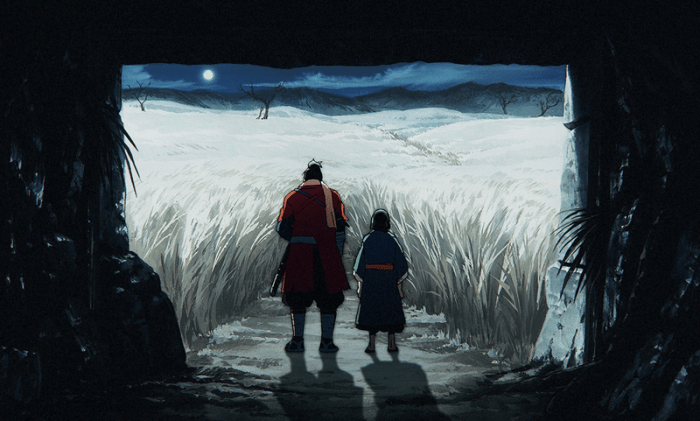
L-R: Wolf voiced by Daisuke Namikawa and Lord Kuro voiced by Miyuki Satou in SEKIRO: NO DEFEAT. Photo courtesy of Fantasia International Film Festival. ©2019 FromSoftware, Inc. All rights reserved. ACTIVISION is a trademark of Activision Publishing Inc. All other trademarks and trade names are the properties of their respective owners. ©KADOKAWA/Sekiro: No Defeat PARTNERS.
Despite all of this, however, the film is often difficult to stay locked in on. As a three-act tale, it often feels structured like a television program with high intentions but low foundational on-boarding so that aspects shown or mentioned fail to achieve the greater intentions they seek due to what the audience lacks. It doesn’t help that even the beautifully animated imagery used to fill in gaps is often so ethereal as to create more questions than provide concrete explanations. The good news is that, by the third act, those still invested understand enough that we care about the fate of the Dragon’s Heritage line. We may not fully understand how its existence is damaging others, especially in light of others who already disturb the natural order, but we are so invested in the fate of Kuro and Wolf that each blade strike feels like it’s being wielded by a potential executioner. Between these dazzling action set pieces, the moving animation, and the themes, there’s plenty to keep people interested, even if the narrative feels a little too mythological to truly grasp.
Screening during Fantasia International Film Festival 2026.
Releasing in Japanese for three weeks starting September 4th, 2026.
For more information, head to the official Fantasia International Film Festival Sekiro: No Defeat webpage.
Final Score: 3.5 out of 5.


Share this:

Categories: In Theaters, Reviews
Leave a Reply