
Trigger Warning: California Scenario includes depictions of self-harm and sexual material that may be difficult for sensitive viewers.
“Art is our weapon. Culture is a form of resistance”
– Shirin Neshat, Iranian photographer and visual artist
Regardless of the generation you are in, parenting is never the same. There’s no rule book, no instruction manual, no precise guide to get it right. Plenty of people have opinions, whole self-help sections full of them, but true, 100% satisfaction guaranteed guidance? Not a chance. One thing is for certain, to do it even partially well, one needs to realize that one’s personal past is our own and not the responsibility of the next generation. Considering the way generational trauma has a tendency to trickle down, this is often easier said than done. This is a critical part of director/co-writer James Takata (We the Parents) new project, California Scenario, having its world premiere during Santa Barbara International Film Festival 2026. At once humorous and heartbreaking, California Scenario is a grounded tale of what parenting can look like in less ideal conditions when broken dreams and lingering horrors exist on the fringes of a parent’s existence with every day a struggle to keep that burden far from their own children.

Will Yun Lee as Jacob Hara in CALIFORNIA SCENARIO. Photo courtesy of SBIFF.
In Southern California, on the exact same day, two single parents find themselves in crisis. The first, Laura (Abby Miller), is preparing for her daughter, Phoebe (Brooklyn Prince), to go stay with Laura’s ex-husband, Joe (Jon Huertas), for the weekend when a sudden discovery derails these plans. The second, Jacob (Will Yun Lee), refuses to take his daughter’s, Lexi’s (Minnie Mills), last-minute cancellation of plans and tracks her down, sensing that something more is going on. As both of them mentally revisit the path that brought them to today, they each find themselves bringing their respective children to the Isamu Noguchi art installation “California Scenario.”

L-R: Abby Miller as Laura Acker and Brooklynn Prince as Phoebe in CALIFORNIA SCENARIO. Photo courtesy of SBIFF.
Written by Takata and Dara Resnik (Studio 60 on the Sunset Strip; Daredevil; Castle), the film starts as a simple tale of parents trying to connect with their children to varying degrees of success and failure and reveals itself to be a multi-generational story in which trauma is the prominent connection. For Laura, it’s rooted in her mother’s, Renee’s (Ellen Greene), unresolved trauma from surviving the Holocaust and, for Jacob, his family’s experience in the Japanese Internment Camps during World War II. This isn’t a spoiler as Laura reminds Phoebe during an early conversation about why Renee rarely throws things away (within the context of trauma responses) and the inclusion of Jacob’s father, Bill (James Saito), immediately recalls the era of prosperity, internment, and forced starting over for the U.S. Japanese population. The coming to “California Scenario” is, itself, symbolic in nature as Noguchi himself survived the Poston camp and the installation he would later create would incorporate the various climate conditions of the state in one place. In essence, the inclusion of “California Scenario” speaks to the ways that the things that make us who we are perpetually stay within us; our skin, our musculature, our souls are the very housing for these experiences. In this installation, one can climb rocks of a barren climate, rest under trees, or let your fingers break a bubbling brook’s horizon — all variable parts of the collective whole of California. Rather than being defined by just a single part, the installation invites visitors to experience it all and come to an understanding of the peace the harmony of these disparate pieces bring. It’s a powerful choice by Takata and Resnik to locate a significant portion of the film to the installation as it inserts the sense that healing begins by first creating space to offer grace for oneself and that means acknowledging the things that are within one’s control and outside of it.
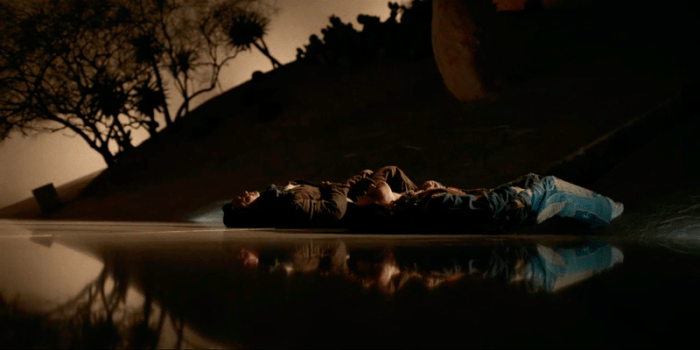
A scene in CALIFORNIA SCENARIO. Photo courtesy of SBIFF.
One of the big notions that courses throughout California Scenario is that time is not linear, but overlapping. This may sound like unscientific, philosophical (even religious) hokum, but consider how the mind works in terms of memory. How often does one do something in the present and find themselves thrust backward into a place or moment thanks to a scent, a sound, a location, or a person? One can be emptying the dishwasher, dancing in the kitchen to the tunes streaming off an iPod and suddenly find themselves at a high school dance, a college job, preparing for a date, or back at one’s wedding — such is the power of memory to transport someone through time without going anywhere. This is how grief and pain can course through a body with the same power now as then, especially if not treated through cognitive tools or therapy. For the film, cinematographer Yasu Tanida (This Is Us) incorporates specific stylized choices to signify when a scene time travels. For all of them, the color grading changes, the natural, warm lighting infuses with more blues and greys. Almost all of the flashbacks occur without warning, like an intrusive thought that pops in and out, but these aren’t just foul images or words of internal-directed spite, they are reminders of violence done upon them by others (physical and psychological) or recollections of moments in which connection was lost despite best efforts to protect or reclaim them. In their softer, more shadowed memories, we, through Laura and Jacob, discover truths of who they are as people and how, despite themselves, pass on traumas to their children. An interesting choice in the cinematography is the shifting aspect ratios which move between 3:2 (or 4:3 with rounded edges like an old photo, furthering the notion of old memories) to a traditional 1.85:1. One can interpret such a choice in different ways, but the read I get implies that the world of Laura and Jacob is so small until their arrival at the installation, even if they don’t realize it. Scenes of past and present conflict, discovery of truths and falsehoods, they restrict Laura and Jacob from being who they want to be and how they want to be with their respective children. But upon arrival at “California Scenario,” this place that holds not just a representation of the state, but is a place that contains within it Noguchi’s own complicated relationship with the U.S., everything bursts open wide.

A scene in CALIFORNIA SCENARIO. Photo courtesy of SBIFF.
Speaking as a parent with a complicated past, California Scenario can be a lot to handle. Prior to marriage, my now-wife (and EoM Editor) Crystal and I would joke that we would do our best not to screw up our kids in the same ways we had been, we would screw up our kids, just in different ways, and none of them intentionally. To a degree, that’s been largely true. My children are not treated as my therapists nor are they sensitive to my moods in the way I was to adults in my life growing up. We teach them that their emotions are their own and quite valid, but how they act on their emotions may not. Modeling regulation techniques for them is hard because I’m learning how to regulate at the same time and putting those techniques into practice for the first times while teaching them how to, but something must be going well because (on the good days) my children are incredibly affectionate, seeking hugs and kisses or offering them when they think I need them. At the same ages they are, I wouldn’t have done that with my parents despite wanting to because I was unsure of which version of that parent I might receive. It’s not that my parents are or were cold, so much as they didn’t have the awareness of or tools to regulate themselves and to better handle the things that happened to them. The way that Takata and Resnik present and give space to the traumas of Laura and Jacob, as well as to the reverberating impacts on daughters Phoebe and Lexi, is raw and honest, unflinching even, at their most uncomfortable without making them less than human. It’s an incredibly hard line to walk and, even when the performances feel less than authentic with a line-reading (vs. delivery) here and there, one stills finds themselves taken by these characters.

L-R: Will Yun Lee as Jacob Hara and Abby Miller as Laura Acker in CALIFORNIA SCENARIO. Photo courtesy of SBIFF.
Trauma without hope is a death sentence. Parenting without confronting that trauma is a guarantee that the past will forever exist in the present, passed down until someone in the line stops it. Amid presenting the absolute difficulty and reality of divorced families, there remains hope because, at the end of the day, as long as shitty parents still put their children first, there’s a chance that the trauma can end with us. That the borders of who we are can find piece in any time, in all the moments of our lives. Though not all the beats land as impactful as intended, there’s no doubt of the poetry that exists within California Scenario and the resonance it creates within the audience.
Screening during Santa Barbara International Film Festival 2026.
For more information, head to the official California Scenario website.
Final Score: 4 out of 5.


Share this:

Categories: In Theaters, Reviews
Leave a Reply