
“And so he told me his secret formula for happiness. Part one of the two-part plan was that I should just get on with ordinary life, living it day by day, like anyone else. But then came part two of Dad’s plan. He told me to live every day again almost exactly the same. The first time with all the tensions and worries that stop us noticing how sweet the world can be, but the second time noticing.”
Domhnall Gleeson’s Tim in About Time (2013)
Cinema is a form of time-traveling storytelling. From the moment a film is released, it’s time-locked; its performances, its narrative, its clothes, frozen in that specific period. While not everything can withstand the test of time, there’s no denying that the act of recording enables audiences to travel back to that specific moment anytime they like, even if it’s a time or place, even if it involves a person or people no longer accessible to us. In that way, cinema can be a bittersweet and contemplative experience, especially when revisiting films we loved from adolescence as adults. A sense forms of irrevocable perspective, that we cannot go back, no matter how much we long to, forming within us a liminal space of then vs. now. Exploring these ideas in a personal and concrete way is first-time feature filmmaker Robie Flores with The In Between, screening during New Orleans Film Festival 2024 in advance of its wide release February 2025.
The In Between is a raw story of loss, love, home, and reclamation through the specific lens of existing literally and metaphysically on a border. Flores left Eagle Pass, Texas, the area she was raised in, to turn the passion of filmmaking, which she shared with her brother Marcelo, into a career. She then returns home after his death. The film features a mix of handheld footage of Eagle Pass as it is now, shot by Flores and surviving brother Alejandro, alongside footage taken by all the Flores siblings then. The footage is accompanied by voiceover work from Flores along with sprinkles of current locals given several showcase moments. Experimental in execution, Flores’s documentary lacks a traditional structure wherein audiences are introduced to members of the family, friends, or acquaintances, each given their own name marker or opportunity to share their thoughts on Marcelo as his death is the catalyst for the project; rather, the film is like a flowing dream or stream of consciousness in which images follow thoughts shared via voiceover or vice versa.
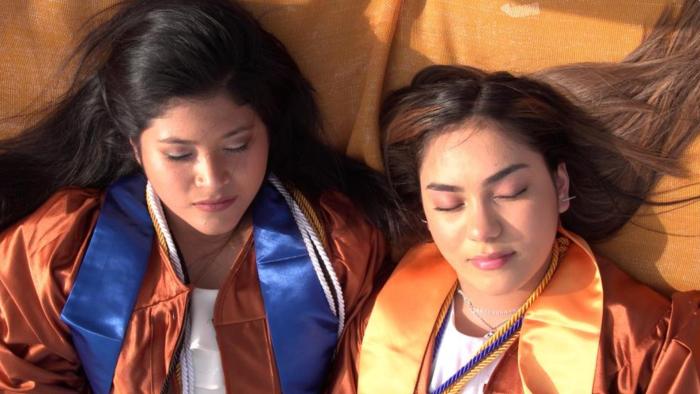
A scene from THE IN BETWEEN. Photo courtesy of New Orleans Film Festival.
To that end, while there is a sort of structure, Flores doesn’t so much walk audiences through her memories as she more so holds their hand as she swims from moment to moment, going wherever they lead. It’s disorienting, to a degree, with only Flores herself and the visual form (moving and still) of her brother Marcelo as the markers on the path the narrative, loose as it is, follows. Don’t mistake this to mean that The In Between is a flurry of images and sound, it’s a series of segments, sometimes logically connected, like watching kids at football practice turn into a car ride wherein two people in the front seat talk about what it’s like for the kid in the back to be at practice, with the conversation shifting to the backseat kid’s “gringo” status as he prefers English to Spanish and, when speaking Spanish, doesn’t do it as well as they. It’s not bullying so much as familial ribbing, though you can see how it does bother the kid in the back. This is a small moment that’s a doorway to a larger one, forming a pivotal element of this kid’s self-perception. As disconnected as it is to the loss of Marcelo, it’s not from how Flores views herself or the state of being she finds herself in, lost between a state of physical existence and metaphysical absence.
And this is where The In Between finds its strength and why audiences hold on tight from start to finish. As Flores is, herself, in between states of being, she goes back to her home, a place that’s literally on the border between two countries, Mexico and the United States of America, where life is routinely split between two worlds and identities, traditions and customs, and, most of all, expectations. The whole of the film is, itself, in between. It’s in between documenting these moments as Flores sees them and archiving those of Marcelo and others in Eagle Pass; it’s in between her past and her present; and it’s in between the confounding (to this writer) struggle of “what’s American versus what’s Mexican,” as though one has to choose when deciding which culture they most connect with as a person. The whole of the film exists in a liminal space and that abstract sense intrigues and mystifies as it may equally frustrate. We’re given contextual information to know who some of the members of Flores’s family are, but less so about the others who she records. Perhaps it’s on purpose, because to give them a name, a relationship, an identity beyond “kid in backseat” that we apply would be to place an anchor in the moment she’s recording where the lack of concrete details enables each person to become akin to a cypher, a manifestation for who Flores and Marcelo were as kids and how their struggles, their experiences, were not only valid but continue on by those who still reside in Eagle Pass.
The In Between is a story of transition. A grief turned to action in order to process a world without someone that meant to much. Action that creates opportunity to take a look at a place likely not thought of in the humdrum lives of the average non-border living citizen of any country. An opportunity that enables one to cross from one state of being into another by forcing oneself to look backward and forward. Flores comments at one point that the recording her brother did may have been different than her own, that his intent may be to capture the mundane, the ordinary, so that he can revisit it. For all the good and bad days, life is just perpetual, filled with the mundane made wonderous or tragic by what occurs within the space of one moment to another. Flores bravely invites us into the rawness of her grief, capturing Eagle Pass as a physical place and as a metaphor for her grief similarly without restraint, so that the mundane can be heroic and the tragedy can soften to something more bearable. It may not answer the questions a traditional documentary may, but The in Between takes risks to ask the questions it seeks to pose.
Screening during New Orleans Film Festival 2024.
Premiering via PBS’s Independent Lens series on February 10th, 2025.
For more information, head to the official New Orleans Film Festival 2024 The In Between webpage.
Final Score: 3.5 out of 5.

Share this:

Categories: In Theaters, Reviews
Being from Eagle Pass, born, raised, and active citizen, I found this film so profound and I will watch it many times probably with tears. I am proud of the young people who created this piece of history about our town. Beyond grateful!