
Why do once-beloved directors fall out of favor with the public, even when they feel that they have grown as artists? Welcome back to Blockbuster Bets, an Elements of Madness series exploring one of 2024’s biggest stories: the directors, established and not, who’ve bet on themselves and funded their own films. This week we’re exploring the second biggest swing of the year, Kevin Costner’s (JFK; Bull Durham) fourth directorial effort, Horizon: An American Saga — Chapter 1. It’s a film unlike any other trying to be like so many films of the past. It’s his love letter to the western genre (again), it’s the first in a (supposed) four-part saga, it’s pretty good, and it’s absolutely insane. It’s largely funded by a new mortgage on Kevin Costner’s $50 M Santa Barbara estate, complicating his divorce proceedings. It’s a big bet.
Kevin Costner is an actor/director who has spent his entire career trying to either interrogate or represent the American myth and promise. So, it’s no wonder that his Blockbuster Bet is a return to the past. Horizon: An American Saga — Chapter 1, one of the most fun film titles to say out loud to completion in casual conversation, is an interrogation of manifest destiny and Western expansion. In this case, an interrogation that lasts three hours long and stopped short right when the real information was about to be conveyed.

Director Kevin Costner in New Line Cinema’s Western drama HORIZON: AN AMERICAN SAGA CHAPTER ONE, a Warner Bros. Pictures release. Photo Credit: Richard Foreman. © 2024 Warner Bros. Entertainment Inc. All Rights Reserved.
Horizon: An American Saga — Chapter 1 is not successful as a blockbuster in shape or in ticket sales, but it is an incredible experience, and my favorite four-star, flawed film of the year. I absolutely adore it, and nothing else this year gave me whiplash from indignation to joy like the moment I realized that the roughly four groups of characters weren’t going to meet and that the last five minutes of the film were an un-telegraphed, overture-scored trailer for Horizon: An American Saga — Chapter 2. With no dialogue. It was a five-minute work of montage and pure imagery that surprised me with how much it stirred me. The grand success of Horizon: An American Saga — Chapter 1 is that its characters are so great (they’re my best friends; I love them and want the best for them, please and thank you), that by withholding their convergence, Costner both cuts chapter 1 off at the knees, and makes those who see it desperate to see chapter 2, sabotaging the present for a promise that may not be fulfilled — an American film indeed.

Owen Crow Shoe (Center) as Pionsenay and Tatanka Means (Right) as Taklishim in New Line Cinema’s Western drama HORIZON: AN AMERICAN SAGA CHAPTER ONE, a Warner Bros. Pictures release. Photo Credit: Richard Foreman. © 2024 Warner Bros. Entertainment Inc. All Rights Reserved.
As the old joke goes, America is just three corporations in a trench coat. Costner would disagree, but in Horizon: An American Saga — Chapter 1, Costner does agree that it’s all about business — the business of colonization, genocide, homemaking and homesteading, revenge, fighting for what’s right, and giving your enemy (or lover) the business. Its romantic score and classical, epic compositions are sorely missed in a Hollywood addicted to temp scores, grey sludge, and ungraded S-log 2, and its money-making strategy is all about the business of Hollywood, as well. Costner insists that DVD sales and TV rights will make back the money he got from mortgaging his mansion. The confluence of a movie about the business of America’s past and Hollywood’s is what makes the meta-text of the proposed Horizon saga so compelling. Twenty years ago, if a best picture-winning director and movie star declared that DVD sales would fund their most about-something passion project film in decades, everyone would say “yes, of course, that’s how movie money works.” But today, we say “God, I wish,” because there is nothing that American business loves more than pushing a leader of industry and commerce’s idea of “progress” at the expense of what is good. It’s what we have always done, and it’s what Netflix has done to us.
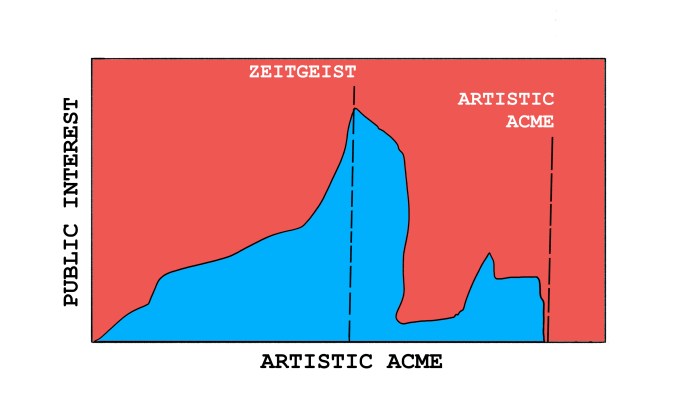
Kevin Costner has always been influenced by the past, especially the John Ford Western and the [Frank Capra] romantic drama. Like most artists, he cannot shake the things that made him fall in love with his medium in the first place and has only grown the way he understands, reshaping the romanticism and machismo of the American West and dream. Time has not passed Kevin Costner by, but we have. Everyone is an artist. I truly believe that. But what makes someone’s art worth your time, commercially, is their point of view. Normal people call this “talent,” or “natural ability,” but what impresses people is skill, earned through practice, and paired with a point of view. But what is a point of view aimed at? What are artists looking towards that’s so compelling the rest of us pause to follow their gaze? An artist’s point of view is fixed on a destination, a moment or method of expression that will satisfy the itch they must bear like a cross for all time. They are looking at their acme, a point of completion and evolution that they will almost never reach high enough to scratch. It is the path they take to pursue that zenith, emotional, ethical, methodological, that becomes “the work.” The Art. This is what makes someone’s art speak to someone else, that compels them to move down their own path in some way. The act of seeing someone pursue their acme moves our hearts and shapes our minds. The act of seeing someone move down a stretch of path we are almost all walking down together at the same time moves millions of dollars and shapes culture. This is the zeitgeist. This is what makes blockbusters.
Blockbuster Bets – HORIZON. Photo credit: Andrew Eisenman.
When an artist is crossing over with the zeitgeist, their interests and influences are the interests and influences of the public, whether in technique or inspiration. This is why new or young artists “break out” and become “hip” or “trendy” more often than middle-career or late-career artists; their influences are the most current with the people driving the culture, but that type of synergy is difficult to maintain. In order to pursue their acme, three paths are often taken. The first is the deposit of new interests and influences, keeping the artist in step with the zeitgeist. This is why Spielberg (Jaws; The Fablemans), Spike Lee (Do the Right Thing; Malcom X), Ryan Murphy (Glee; American Horror Story), Greta Gerwig (Little Women (2019), Barbie), Jordan Peele (Get Out; Nope), and Adam McKay (Don’t Look Up; The Big Short) are able to maintain their status as populist filmmakers for so long in their careers. Their engagement with either current events, current trends, or current attitudes keeps us feeling seen and engaged with. The art remains timely. Other artists turn to technological advancement in order to pursue their acme. For James Cameron (Avatar; Avatar: The Way of Water), this has worked wonderfully and has given us two of the defining movies of the century. For the likes of Robert Zemeckis (Welcome to Marwen; The Polar Express), Peter Jackson (The Beatles: Get Back; Mortal Engines), and Ang Lee (Gemini Man; Billy Lynn’s Long Halftime Walk), this road has become a cul de sac preventing them from evolving further, leading even to regression in technique, popularity, and artistic evolution. The art remains fancy. Finally, artists like David Lynch (Eraserhead; Twin Peaks: The Return), Francis Ford Coppola (One from the Heart; Megalopolis (more on this in a few weeks)), the Wachowskis (Speed Racer; Cloud Atlas), and the late-great Nobuhiko Obayashi (The Little Girl Who Conquered Time; House) pursue their acme through the evolution of the cinematic form. Pushing past the proscenium, rejecting the conventions of reality, or attempting to more closely relate thought, emotion, or history to the meaning of their images. The art remains innovative. Kevin Costner has chosen this path, but his cinematic innovation is that of serialization, not akin to TV, but of the paperback novel.
In serialized novels, it is not uncommon to finish on an open-ended but shocking moment. This is then followed, on occasion, by an afterward and a “preview chapter” of the next novel. This is most common in serialized YA novels, but it does happen in adult fiction. A refrain from Costner during the promotional tour for his last directed film, Open Range (2003), was that he wanted it to feel like reading a good novel. It’s only natural that as he’s progressed farther towards his acme, he’s gone further in his attempts to replicate the feeling of reading a pulpy adventure/Western book, an essential element to all of his directed films. If you push aside the patriotism and machismo, that’s really what his oeuvre is all about.

Luke Wilson as Matthew Van Weyden in New Line Cinema’s Western drama “Horizon: An American Saga” Chapter One, a Warner Bros. Pictures release. HORIZON: AN AMERICAN SAGA CHAPTER ONE, a Warner Bros. Pictures release. Photo Credit: Richard Foreman. © 2024 Warner Bros. Entertainment Inc. All Rights Reserved.
When the middle film of a franchise follows the mid-point shape of the three-act structure and sees its heroes at their lowest, we say “It’s the Empire Strike Back (1980) of ____.” Well, Horizon: An American Saga — Chapter 1, in trying to be the The Fellowship of the Ring (2001) of the Horizon saga, comes up short because, unlike The Fellowship of the Ring, we haven’t seen the group together at all yet. Still, the cinematic moment that I think shares more intention in common with the end of Horizon: An American Saga — Chapter 1 than any “next time on” TV segment, is Frodo and Sam setting off on their own towards Mordor. This feeling of an adventure just beginning, of civilization at risk and friends scattered to the winds, all meant to reunite when it matters most, this is what we’re supposed to feel. Instead, it’s built more like the “end” of Zack Snyder’s Justice League (2021), a post-credit scene that has broken containment and became an epilogue for one film and a prologue for a film that will never be made. Luckily, Horizon: An American Saga — Chapter 2 is supposedly already in the can.

A scene from New Line Cinema’s Western drama HORIZON: AN AMERICAN SAGA CHAPTER ONE, a Warner Bros. Pictures release. Photo courtesy of Warner Bros. Pictures. © 2024 Warner Bros. Entertainment Inc. All Rights Reserved.
Kevin Costner has bet big with Horizon: An American Saga — Chapter 1. He’s bet that the Western is still popular (the neo-Western maybe), that his aged audience would return to theaters (many underestimate not just how many retirement-aged people remain isolated, but how many didn’t survive the first few years of COVID, and how many of those who did have no income left), and that DVD sales would bring the film profits and positive word-of-mouth. Where has he come up short? I do believe that Blu-ray and DVD sales can still bring a film to profitability. Not that it needed it, but Oppenheimer’s (2023) 4K disk literally sold out within a week just last year. But Kevin Costner is no longer in the zeitgeist, despite what people who watch Yellowstone (2018 – present) tell you. Horizon: An American Saga — Chapter 1 is his most currently engaged work, maybe ever. Like Dances with Wolves (1990) before it, its engagement with the plight of Indigenous tribes is better than you’d expect, but still comes up short of works like Killers of the Flower Moon (2023), The Unknown Country (2023), or Reservation Dogs (2021-2023). He is genuinely interested (but not yet effective) in exploring the way that capital powers genocide and exploit the poor as weapons of colonization through his invention of Giovanni Ribisi’s (Avatar; Strange Darling) Horizon venture as an East-India Trading Company analog in America’s Western Expansion. He is interested in the way that Chinese immigrants are often cut out of the history of The Wild West, that the Civil War created an opening for settlers to skirt around Federal treaties with Indigenous nations, and how oppression and revenge intermingle to create unending generational conflict. These are all thoughts of the moment, explored in earnest sketches but not thorough dialogue. He is out of step with the audience whose interest he needs to pay for his DVDs, and his romantic earnestness is out of step with the young people whose interests do align with the film. At least, so far. Maybe an affordable two-film box set will swing the odds back in his favor.
Next time on Blockbuster Bets, we’ll once again be discussing the way first-time filmmakers bet on themselves with the yet-to-be-sold film Sendero.
In theaters June 28th, 2024.
Available on digital July 16th, 2024.
Available on Max August 23rd, 2024.
Available on 4K UHD and Blu-ray September 10th, 2024.
For more information, head to the official Warner Bros. Pictures Horizon: An American Saga – Chapter 1 webpage.

Share this:

Categories: Films To Watch, Recommendation
Leave a Reply