
Photosensitivity Warning: In one of the later segments of archival photos, they are stylized like old film footage with light blips and visible scratches which may prove triggering for photosensitive individuals.
The evolution of the movie-watching experience is fairly straight-forward. First there were the exhibition halls (a mix of penny arcades, nickelodeons, and vaudeville houses); then movie palaces were built in order to give that high-class, theater-like feel; then came drive-ins; then multiplexes (as city centers were abandoned for suburbs); and now “premium” experiences (recliners, food, 3D, IMAX, or 4DX). Whether movie-goers were trying to survive World War I, the Great Depression, or World War II (and all that followed), the theatrical experience was prized as the pinnacle of feature-length storytelling entertainment. But that experience has been on a downtrend for a number of factors. Having its world premiere at Santa Barbara International Film Festival 2026, Rustin Thompson’s The Last Picture Shows is a melancholic exploration of film exhibition through the American West past and present, highlighting the shrinking grandeur of the theatrical experience and the few who guard the last remaining picture houses.

Sierra Theater of Susanville, CA in documentary THE LAST PICTURE SHOWS. Photo courtesy of Foghorn Features.
The documentary makes two informative declarations that carry forward specific intentions of The Last Picture Shows. The first is a statement identifying that everything contained within the documentary — images, music, everything — is created by humans. It’s a sad state of affairs when a film must, at the top, make such a declaration, but it’s an important one as it relates to artistic expression vs. commerce, a critical element of the juxtaposition between picturehouse success and the industry in which it subsides. Two years ago, filmmaker Michael Bay (Transformers and Bad Boys franchises) stated about artificial intelligence, “it doesn’t CREATE it just IMITATES.” Whatever one thinks of the 6 Underground (2019) director and impetus of the term Bayhem, in a period when A.I. slop is being pushed by tech investors as the means for non-artists to get creative and not as the theft-machine that it is (from where do the data sets that create the generative imagery come, folks?), Thompson’s statement (like Bay’s) is a reminder that what’s found within the runtime of The Last Picture Shows is strictly human-made. This speaks to the artistic side of film creation, but also that there is a human component to operating a theater that goes beyond the notion of the “theatrical experience” as theaters battle the home-viewing experience, distributor greed, and shifts in consumer consumption. Humans touch everything within The Last Picture Shows — all the good and all the bad.

The Washoe of Anaconda, MT in documentary THE LAST PICTURE SHOWS. Photo courtesy of Foghorn Features.
The second declaration is that Thompson travelled to “10 states. 10,825 miles. 123 theaters.” The Last Picture Shows is a story of one individual’s journey to memorialize the last vestiges of cinema. This wasn’t out-sourced to a team. Though Thompson does have a small one, he directed, wrote, produced, DP’d (with additional cinematography by Nick Thompson), edited, and sound mixed it all. This is a project born out of human curiosity, managed by human direction, and executed by human hands. Though the documentary also includes interviews with a handful of owners/operators of pictureshouses big and small, historic and brand-new, Thompson utilizes narration via a talking head interview with Professor Ross Melnick of University of California, Santa Barbara, and archival footage and stills of theaters across the American West to provide a composite history of theaters in the region. Eschewing franchise houses like AMC, Regal, and Cinemark, Thompson goes to places like The Desert Historic Theater in Burns, Oregon; The Etrym in Baker City, Oregon; The Ruby Theater, in Chelan, Washington; The OK Theater in Enterprise, Oregon; and The Washoe in Anaconda, Montana. Each time, where applicable, Thompson puts up original photos at the time of or close to each location’s opening to juxtapose against its present-day appearance. Whether shown in black-and-white or sepia, these photos convey a sense of lost history that current movie-goers are ignorant of and whose absence of awareness only contributes to the belief in theater-going as a by-gone activity. Even before Thompson shows us theaters that are now Subways, churches, or, worse, partial buildings lost to time, the use of archival photography and Melnick’s voice convey this stirring of a history we may never truly understand or recover.

The Etrym of Baker City, OR in documentary THE LAST PICTURE SHOWS. Photo courtesy of Foghorn Features.
In all the kvetching about the modern cinematic experience (higher costs for non-premium experiences; lower overhead for at-home viewing), Thompson makes a strong case for why going to the theater matters — short of going to view a play performed by actors, there’s nothing else like it. For anywhere from 90 minutes to four hours (minus some outliers), audiences go on an adventure of the imagination in which we are willingly manipulated to believe that what we’re witnessing is true. Doesn’t matter if one is witnessing one man’s struggle with morality (The Seventh Seal), going on a quest to go straight despite outside influences and get a cappuccino (Hudson Hawk), or see what can happen when good people stand up to fascism (Captain America: The Winter Soldier), from opening to end credits, we choose to be deceived. At home affords a great deal of comforts, absolutely, but it also brings with it the usual distractions, almost all of which are frowned upon in a theater. Instead, even at the drive-in, we agree (optimistically) to settle-in and share this experience together. Thompson not only makes a strong case for the significance to a community for theater-going, but how it’s also up to the distributors to recognize that not all theaters should be treated equally. One of many things the film brings up and doesn’t fully investigate (not the film’s purpose) is how the innovation of distributors away from film toward digital eases the burden of distributors, but places significant weight on the theater owners; how each distributor often requires unfair requirements to grant access to the film; and how the absence of government intervention during the early days of COVID-19 nearly wiped out the theater industry. This is perhaps the strongest piece of Thompson’s documentary and it’s given the least amount of time within its full 78-minutes. Without theaters, distributors have no place to screen their films, the preference to obtain the most money out of each picture often ends up hurting the individual theaters, which, as a result, hurts the local community and the distributors in different yet significant ways.
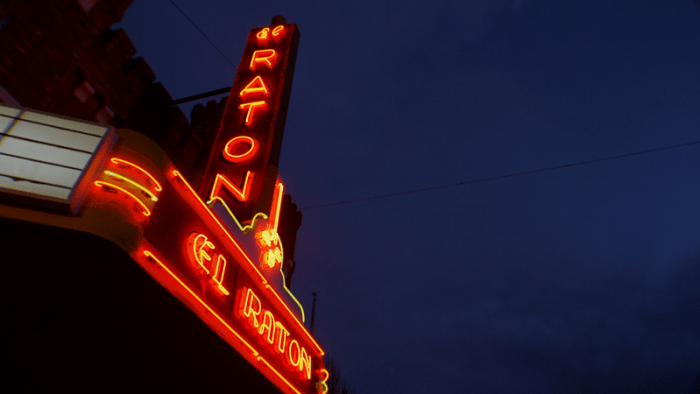
El Raton Theatre of Raton, NM in documentary THE LAST PICTURE SHOWS. Photo courtesy of Foghorn Features.
At a time of incredible divisiveness with a dictatorial government rising up, the loss of theaters may feel like the least important concern. However, art is how people survive dark times. Music, poetry, painting, writing, construction — each of them offers a glimmer of hope and serves as an act of rebellion. To make art is to declare one is alive and, for filmmakers, they need places to show their work. This all starts at home, locally, in their community. But where do artists go when all the theaters are gone? Speaking as a critic who has seen opportunities to screen films ahead of release dry up in favor of larger markets and influencer marketing, the focus on business-only thinking doesn’t expand one’s bottom line, it shrinks it. You may have the biggest film in the top three markets, but who gives a damn if the rest of the country can’t see it? If not for places in Charlotte, North Carolina, like Independent Picture House or The Ayrsley Grand Cinemas or in my hometown of Roanoke, Virigina, like The Grandin Theatre, one might never see Hundreds of Beavers (2023), The Voice of Hind Rajab (2025), Fuck My Son! (2025), or a slew of repertory works alongside the latest Jason Statham actioner or Disney animated feature. Theaters used to be a place where people came together, each one a vision of their operator that spoke distinctly to the community itself. When we lose that, we lose something of ourselves, too.
Screening during Santa Barbara International Film Festival 2026.
For more information, head to the official The Last Picture Shows webpage.
Final Score: 3.5 out of 5.


Share this:

Categories: In Theaters, Reviews
Leave a Reply